Baptist Militia A library & museum of the Whole Armour of God Visit
Find

Hall II · The Gallery

Things seen and handled

“That which was from the beginning, which we have heard, which we have seen with our eyes, which we have looked upon, and our hands have handled, of the Word of life;”1 John 1:1, KJV

Four rooms of real objects in the world’s museums and libraries: the Book that was preserved, the text received and carried into English, the armour Paul named, and the witness of Baptists who took up the word of God at cost. Every plate is public domain or shown under its published licence, and every label carries its source.

Room I

The Book Preserved

“The words of the LORD are pure words: as silver tried in a furnace of earth, purified seven times. Thou shalt keep them, O LORD, thou shalt preserve them from this generation for ever.”

Real pages, copied by hand long before the printing press, that still carry the words of Scripture. The King James Version was translated from the Hebrew Masoretic Text and the Greek Received Text (Textus Receptus); the manuscripts shown here are witnesses to how early and how widely those words were copied, not the texts from which the King James translators worked. (source)

Papyrus 46, folio 157 verso (Ephesians 6:8–18). University of Michigan Papyrology Collection, via Wikimedia Commons · Public domain

Plate I.1

Papyrus 46: the armour passage on papyrus

Date
c. AD 175–225
Held at
University of Michigan Papyrology Collection, Ann Arbor (P.Mich. inv. 6238)

A leaf from the oldest surviving copy of Paul’s letters, bearing Ephesians 6:8–18: the very passage this museum is built upon.

Papyrus 46 is a codex (an early book, not a scroll) of Paul’s epistles in Greek, one of the Chester Beatty Biblical Papyri. Its surviving leaves are divided between the Chester Beatty Library in Dublin and the University of Michigan, which holds the leaves containing Ephesians. Its date rests on handwriting alone, and scholars differ: the most probable range is usually given as AD 175–225, with some arguing earlier and others for the early third century. The bottom lines of each leaf have worn away, but on this page the words of Ephesians 6 about the whole armour of God can still be read.

“Put on the whole armour of God, that ye may be able to stand against the wiles of the devil.”

Source en.wikipedia.org — Wikipedia, “Papyrus 46” (citing F. G. Kenyon, The Chester Beatty Biblical Papyri III, 1934; B. Griffin, “The Paleographical Dating of P-46,” 1996; P. Orsini and W. Clarysse, 2012). Leaf-by-leaf holdings per the same article.

Rylands Papyrus P52, recto (John 18:31–33). John Rylands Library, University of Manchester, via Wikimedia Commons · Public domain

Plate I.2

The St John fragment (Rylands Papyrus 52)

Date
c. AD 100–175
Held at
John Rylands Library, Manchester (P. Rylands Gr. 457)

A scrap of papyrus the size of a credit card, generally accepted as the earliest surviving piece of any New Testament book.

Written on both sides, and therefore torn from a codex rather than a scroll, the fragment preserves parts of John 18:31–33 on the front and 18:37–38 on the back: Jesus before Pilate. It was bought in Egypt in 1920 by Bernard Grenfell and first published by C. H. Roberts in 1935. Roberts dated it to the first half of the second century. A later survey by Orsini and Clarysse proposed AD 125–175, and a few scholars allow a wider range.

“Pilate saith unto him, What is truth? And when he had said this, he went out again unto the Jews, and saith unto them, I find in him no fault at all.”

Source en.wikipedia.org — Wikipedia, “Rylands Library Papyrus P52” (citing C. H. Roberts, An Unpublished Fragment of the Fourth Gospel, 1935; Orsini and Clarysse, 2012; B. Nongbri).

The two Ketef Hinnom silver amulets, unrolled, as displayed in the Israel Museum, Jerusalem. Photo: Bachrach44, via Wikimedia Commons · CC BY-SA 3.0

Plate I.3

The Ketef Hinnom silver amulets: the Priestly Blessing

Date
c. 600 BC (found 1979)
Held at
The Israel Museum, Jerusalem

Two tiny rolled sheets of silver from a Jerusalem tomb, inscribed with the blessing of Numbers 6:24–26: the oldest surviving texts yet known of words found in the Hebrew Bible.

In 1979 a team led by the archaeologist Gabriel Barkay, then of Tel Aviv University, was excavating burial caves at Ketef Hinnom, just southwest of the Old City of Jerusalem. The tomb looked empty, but a partial collapse of the ceiling long ago had sealed the repository beneath one chamber (Chamber 25 of Cave 24), and it held more than a thousand objects. Among them were two small rolled sheets of silver, now called KH1 and KH2, the larger measuring only 27 by 97 millimetres and the smaller 11 by 39. When unrolled, both proved to be incised in the old Paleo-Hebrew letters with a form of the Priestly Blessing: “The LORD bless thee, and keep thee.” KH1 also carries words close to Deuteronomy 7:9, of the God who keeps covenant and mercy with them that love him and keep his commandments. Barkay dated the inscriptions to the late seventh or early sixth century BC. Johannes Renz and Wolfgang Röllig doubted that the worn script could be dated so surely, so the amulets were re-examined with advanced photography and computer imaging by the University of Southern California’s West Semitic Research Project. Their study, published in 2004, confirmed a date shortly before the Babylonians destroyed Jerusalem in 587/6 BC, some four centuries before the Dead Sea Scrolls. Honesty requires a note. These are amulets, carrying a few lines of the blessing, not copies of the book of Numbers, and scholars such as Wayne Pitard and James Davila caution that they show how old the blessing is without by themselves settling when the whole book was written. Jeremy Smoak has suggested that this custom of written silver lies behind Psalm 12:6–7, the verse that heads this room.

“The LORD bless thee, and keep thee: The LORD make his face shine upon thee, and be gracious unto thee: The LORD lift up his countenance upon thee, and give thee peace.”

Source en.wikipedia.org — Wikipedia, “Ketef Hinnom scrolls” (citing G. Barkay et al., Near Eastern Archaeology 66/4, 2003, and BASOR 334, 2004; J. Renz and W. Röllig, 1995; New York Times, 28 Sept 2004; J. Davila, 2004; J. Smoak, Vetus Testamentum 60, 2010). Num 6:24–26 KJV verified.

The Nash Papyrus, as photographed for the Proceedings of the Society of Biblical Archaeology 25 (1903), p. 56. Via Wikimedia Commons · Public domain

Plate I.4

The Nash Papyrus: the Ten Commandments and the Shema

Date
c. 150–100 BC (first described 1903)
Held at
Cambridge University Library (MS Or.233)

Four fragments of a single papyrus sheet from Egypt, written in Hebrew with the Ten Commandments and the opening of the Shema, “Hear, O Israel.” Until the Dead Sea Scrolls were found in 1947, it was the oldest Hebrew manuscript fragment of the Bible known.

The papyrus was acquired in Egypt by W. L. Nash, secretary of the Society of Biblical Archaeology, who presented it to Cambridge University Library in 1903. Where in Egypt it was found is not known, though it is said to have come from the Fayyum. The four fragments make up one sheet, not part of a scroll: twenty-four lines of Hebrew, with a few letters lost at each edge. Stanley A. Cook first described it in 1903 and dated it to the second century after Christ. Later reappraisals, among them W. F. Albright’s 1937 study “A Biblical Fragment from the Maccabean Age”, pushed the date back to about 150–100 BC. The sheet holds the Ten Commandments, then a short connecting sentence like Deuteronomy 4:45, then the beginning of the Shema of Deuteronomy 6:4. Honesty requires a note. This is not a copy of Exodus or Deuteronomy. Its Commandments blend the wording of Exodus 20:2–17 with that of Deuteronomy 5:6–21. It leaves out the words “house of bondage”, and it places adultery before murder, as most texts of the Septuagint do. In places it differs from the Masoretic Hebrew text from which our Authorised Version’s Old Testament was translated. Both Talmuds record that the Ten Commandments were once read daily before the Shema, so F. C. Burkitt, writing in 1903, judged it “reasonable to conjecture that this Papyrus contains the daily worship of a pious Egyptian Jew who lived before the custom came to an end.” Weighing its variants, Burkitt concluded: “So far as the Decalogue and the Shema’ go, the Massoretic text appears to me the more archaic and therefore the more genuine.” The papyrus is a witness that the words written with the finger of God and the great confession “The LORD our God is one LORD” were being prayed in Hebrew more than a century before Christ.

“Hear, O Israel: The LORD our God is one LORD:”

Source en.wikipedia.org — Wikipedia, “Nash Papyrus” (citing Cambridge Digital Library MS Or.233; S. A. Cook, PSBA 25, 1903; F. C. Burkitt, JQR 15, 1903 and JQR 16, 1904; W. F. Albright, JBL 56, 1937; M. Greenberg, Encyclopaedia Judaica); F. C. Burkitt, “The Hebrew Papyrus of the Ten Commandments”, Jewish Quarterly Review 15 (1903), 392–408 (PD), quoted from pp. 398–399 and 402. Deut 6:4 KJV verified.

The Great Isaiah Scroll, the column containing Isaiah 53. Photograph by Ardon Bar-Hama for the Israel Museum, via Wikimedia Commons · Public domain

Plate I.5

The Great Isaiah Scroll

Date
c. 125 BC
Held at
The Israel Museum, Jerusalem (Shrine of the Book)

All sixty-six chapters of Isaiah on one parchment scroll, found at Qumran in 1947 and about a thousand years older than any Hebrew copy known before it.

The Great Isaiah Scroll (1QIsa-a) was one of the first seven Dead Sea Scrolls discovered at Qumran in 1947. It is 734 cm long, the largest and best preserved of the biblical scrolls, and the only one that is almost complete: its 54 columns hold all 66 chapters of Isaiah. The Israel Museum dates it to about 125 BC. Its text, says the Museum, is generally in agreement with the Masoretic, or traditional, Hebrew text codified in the medieval codices, though it contains variant spellings, scribal errors and corrections. The column shown here contains the prophecy of the suffering Servant, Isaiah 53.

“The grass withereth, the flower fadeth: but the word of our God shall stand for ever.”

Source dss.collections.imj.org.il — The Israel Museum, Jerusalem, “The Great Isaiah Scroll,” The Digital Dead Sea Scrolls (curator: Adolfo D. Roitman).

Codex Alexandrinus, folio 41 verso (end of Luke). British Library, via Wikimedia Commons · Public domain

Plate I.6

Codex Alexandrinus: the close of Luke

Date
5th century AD
Held at
The British Library, London (Royal MS 1 D. V–VIII)

A fifth-century Greek Bible on parchment, presented to the English crown in the reign of Charles I.

Codex Alexandrinus contains most of the Greek Old Testament and the Greek New Testament, and is dated by its handwriting to the fifth century. It takes its name from Alexandria, from which Cyril Lucaris, patriarch first of Alexandria and then of Constantinople, brought it to Constantinople in 1621. Lucaris offered it to James I in 1624 through the English ambassador, Sir Thomas Roe; James died before it could be sent, and it was given to Charles I in 1627. It therefore reached England sixteen years after the King James Version was published. In the Gospels its text is of the Byzantine type; in the rest of the New Testament it is Alexandrian. The page shown is folio 41 verso, the end of the Gospel of Luke.

“Heaven and earth shall pass away: but my words shall not pass away.”

Source en.wikipedia.org — Wikipedia, “Codex Alexandrinus” (citing K. and B. Aland, The Text of the New Testament; F. H. A. Scrivener; T. C. Skeat). Arrival date and text-type per the same article.

Codex Washingtonianus (W, 032), last page: the close of Mark 16 with title and subscription. Freer Gallery of Art, Washington; image via Wikimedia Commons · Public domain

Plate I.7

Codex Washingtonianus: “Amen” at the close of Mark

Date
4th or 5th century AD (bought 1906)
Held at
Freer Gallery of Art, Smithsonian Institution, Washington, D.C. (06.274)

The last page of the Freer Gospels, a Greek Gospel book on parchment. The upper block of text is the end of Mark chapter 16, from the signs that follow them that believe to “the Lord working with them, and confirming the word with signs following”, closing with ΑΜΗΝ, “Amen”. Beneath the ornamental border stands the title ΕΥΑΓΓΕΛΙΟΝ ΚΑΤΑ ΜΑΡΚΟΝ, “Gospel according to Mark”, and below that a short prayer added in a later, semi-cursive hand.

Codex Washingtonianus, known by the letter W or the number 032, is a Greek manuscript of the four Gospels on 187 parchment leaves, written in a small, slightly sloping uncial hand and dated to the 4th or 5th century. It is counted the third oldest Gospel codex on parchment in the world. Its Gospels stand in the old “Western” order, Matthew, John, Luke, Mark, so Mark’s ending is also the end of the book. The American industrialist Charles Lang Freer bought it from an antiques dealer in Cairo in December 1906, and Henry A. Sanders of the University of Michigan published it, with a full facsimile in 1912. Bruce M. Metzger called it “the only Greek Gospel manuscript of early date of which we know provenance”, and noted indications that it came from a monastery near the Pyramids. Its text is mixed, drawn it seems from more than one exemplar: in Matthew, and in Luke from 8:13 to the end, it agrees with the Byzantine text, the family of manuscripts behind the Received Text, and it keeps verses such as Matthew 23:14. It also carries the longer ending of Mark, verses 9 to 20, which our King James Version keeps. Honesty requires one more note: after Mark 16:14 the copyist wrote a short passage, called the “Freer Logion”, that is found in no other manuscript. It is not Scripture, and it is not shown here. The prayer under the title, in a 5th-century hand, reads “Holy Christ, be you with your servant Timothy and all of his.”

“So then after the Lord had spoken unto them, he was received up into heaven, and sat on the right hand of God. And they went forth, and preached every where, the Lord working with them, and confirming the word with signs following. Amen.”

Source en.wikipedia.org — Wikipedia, “Codex Washingtonianus” (citing B. M. Metzger & B. D. Ehrman; K. & B. Aland; H. A. Sanders 1912; L. W. Hurtado 2007; INTF). Image: Wikimedia Commons, “Codex W (032) 193b.jpg”, public domain (PD-Art, PD-old-100). Mark 16:19–20 KJV verified.

A Wycliffite New Testament, folio 2v, the opening of John. University of Glasgow Library, MS Hunter 191 (T.8.21), via Wikimedia Commons · Public domain

Plate I.8

A Wycliffite New Testament: the opening of John

Date
late 14th century
Held at
University of Glasgow Library, MS Hunter 191 (T.8.21)

The Gospel of John in Middle English, from the translation that bears John Wycliffe’s name. Below the prologue, the great initial opens the verse: “In þe bigynnyng was þe word & þe word was at god, & god was þe word.”

The Wycliffite Bibles, made between about 1382 and 1395, were the first translations of the whole Bible into English. They were translated from the Latin Vulgate, not from the Hebrew and Greek, and modern scholars are more cautious than older writers about how much of the work was Wycliffe’s own. In 1408 a convocation at Oxford voted that no new English translation should be made in England without approval. Even so, more than 250 Wycliffite manuscripts survive, more than any other Middle English text. This plain, pocket-sized volume holds an incomplete New Testament. Glasgow’s librarians note that many such copies were made small so that travelling preachers could carry them. Its first owner is unknown, but inscriptions on its flyleaves record later owners, among them John Lewis (1675–1747), an early biographer of Wycliffe.

“All things were made by him; and without him was not any thing made that was made.”

Source gla.ac.uk — University of Glasgow Library, Special Collections exhibition (MS Hunter 191: pocket size, incomplete New Testament, the John Lewis inscription). Dates, the Vulgate source, the 1408 convocation and the 250 surviving manuscripts per Wikipedia, “Wycliffe’s Bible”.

Room II

The Text Received

“For ever, O LORD, thy word is settled in heaven.”

How the Hebrew and Greek words came into the English Bible. For the Old Testament the King James translators used the Masoretic Hebrew text in Daniel Bomberg’s printed Rabbinic Bible; for the New Testament, the Greek Received Text (Textus Receptus) in the printed editions of Erasmus, Stephanus and Beza. Many modern textual critics weigh the manuscript evidence differently and prefer older manuscripts that these editors did not use. This museum holds, with many Baptists, that God has providentially preserved His word in the text received by His churches. The plates below show that chain, from the Masoretic codices to the page of 1611. (source)

The Aleppo Codex, a page of Deuteronomy. Photograph by Ardon Bar-Hama, Yad Yitzhak Ben-Zvi Institute, via Wikimedia Commons · Public domain

Plate II.1

The Aleppo Codex, the “Crown of Aleppo”

Date
c. AD 920
Held at
Shrine of the Book, The Israel Museum, Jerusalem (Ben-Zvi Institute)

The Hebrew Bible as the Masoretes wrote it at Tiberias in the tenth century, with every vowel and accent marked; Maimonides described it as a text trusted by all Jewish scholars.

The Masoretes were the Jewish scribes who guarded the Hebrew text, adding vowel points, accents and notes in the margins so that it would be read and copied exactly. The Aleppo Codex, written in Tiberias about AD 920, is the chief witness of the tradition of Aaron ben Moses ben Asher. After the Crusaders took Jerusalem in 1099 it passed to Egypt, where Maimonides consulted it, and it was later kept for centuries in the Central Synagogue of Aleppo. When that synagogue was burned in the riots of 1947 the codex disappeared. By the time it reached Israel in 1958, roughly 40 per cent was missing, including most of the Torah. The page shown is from Deuteronomy.

“Ye shall not add unto the word which I command you, neither shall ye diminish ought from it, that ye may keep the commandments of the LORD your God which I command you.”

Source en.wikipedia.org — Wikipedia, “Aleppo Codex” (date, Ben Asher tradition, Maimonides’ judgment, the 1947 fire and the losses found in 1958).

The Leningrad Codex, folio 8 recto (Genesis 14:12–15:13). Scan by USC Dornsife, via Wikimedia Commons · Public domain

Plate II.2

The Leningrad Codex: Genesis 15

Date
AD 1008 (or 1009)
Held at
National Library of Russia, St Petersburg

The oldest complete manuscript of the Hebrew Bible, copied in Cairo in 1008. This leaf carries Genesis 14:12–15:13, and with it the words “he believed in the LORD; and he counted it to him for righteousness.”

According to its colophon, the codex was copied in Cairo in AD 1008 (or possibly 1009) from manuscripts written by Aaron ben Moses ben Asher. One scribe, Samuel ben Jacob, wrote the letters, the vowels and the Masoretic notes. Because much of the older Aleppo Codex has been lost, this is now the oldest complete codex of the Tiberian Masoretic tradition. It has been in St Petersburg since 1863, and in modern times it is the Hebrew text printed in the Biblia Hebraica editions. The King James translators never saw it. They worked from printed Hebrew Bibles of the same Masoretic tradition (see the introduction to this room).

“And he believed in the LORD; and he counted it to him for righteousness.”

Source en.wikipedia.org — Wikipedia, “Leningrad Codex” (colophon date and place, the scribe Samuel ben Jacob, custody since 1863, use in Biblia Hebraica). Folio contents per the Commons file record.

Complutensian Polyglot Bible, vol. 5, the opening of Matthew. Biblioteca Digital de Castilla-La Mancha, via Europeana and Wikimedia Commons · CC BY-SA 3.0

Plate II.3

The Complutensian Polyglot: the first printed Greek New Testament

Date
NT printed 1514; issued 1520–21
Held at
Copy digitised by the Biblioteca Digital de Castilla-La Mancha

The whole Bible in Hebrew, Aramaic, Greek and Latin, made at Alcalá de Henares for Cardinal Cisneros. Its New Testament volume, printed in 1514, was the first Greek New Testament ever printed.

The scholars worked at the university of Alcalá, whose Latin name, Complutum, gives this Bible its name. The New Testament volume was finished and printed in 1514. Publication then waited on the Old Testament, on the Pope’s sanction in 1520 and on civil war in Castile, so Erasmus’s Greek New Testament of 1516 reached readers first. About 600 six-volume sets were printed, and 123 are known to survive. Later editors of the Received Text used it, among them Erasmus himself in his edition of 1527 and Stephanus after him. The page shown opens the Gospel of Matthew, with the Greek set beside the Latin.

“The book of the generation of Jesus Christ, the son of David, the son of Abraham.”

Source en.wikipedia.org — Wikipedia, “Complutensian Polyglot Bible” (printing and publication dates, surviving sets, use by Erasmus); use by Stephanus per Wikipedia, “Textus Receptus”.

Minuscule 2 (Basel, A. N. IV. 1), the first page of Matthew, via Wikimedia Commons · Public domain

Plate II.4

Minuscule 2: the Gospels Erasmus sent to the press

Date
copied 11th or 12th century · marked for the press 1515–16
Held at
University Library, Basel (A. N. IV. 1)

A Greek manuscript of the four Gospels in the Byzantine, or majority, text. Erasmus borrowed it from the Dominican friars of Basel and used it as the printer’s copy for the Gospels in his first Greek New Testament of 1516. The page marks made for the press in red chalk are still on its leaves.

The codex has 248 parchment leaves, written in a single column of twenty lines to the page. Nothing is known of its early history, but a fifteenth-century note on the last page records that monks at Basel bought it for two Rhenish florins. It has belonged to the University of Basel since 1559. After Erasmus came to Basel in 1514 he wrote about 130 corrections in its margins, and the manuscript was marked up for Froben’s press. Most scholars credit the red chalk to Erasmus himself; Kenneth Clark gave it to the printer’s staff. Erasmus did not simply reprint it: he corrected its slips of the pen and drew on other manuscripts, among them Minuscule 1. Through his edition, on which Stephanus built, many of its readings passed into the Received Text from which the King James New Testament was translated. The page shown opens the Gospel of Matthew.

“Abraham begat Isaac; and Isaac begat Jacob; and Jacob begat Judas and his brethren;”

Source en.wikipedia.org — Wikipedia, “Codex Basiliensis A. N. IV. 1” (date, contents and layout, Byzantine text-type, the florin note, custody since 1559, Erasmus’s use in 1516, the red chalk and its attribution, his corrections, Minuscule 1, the path into the Textus Receptus).

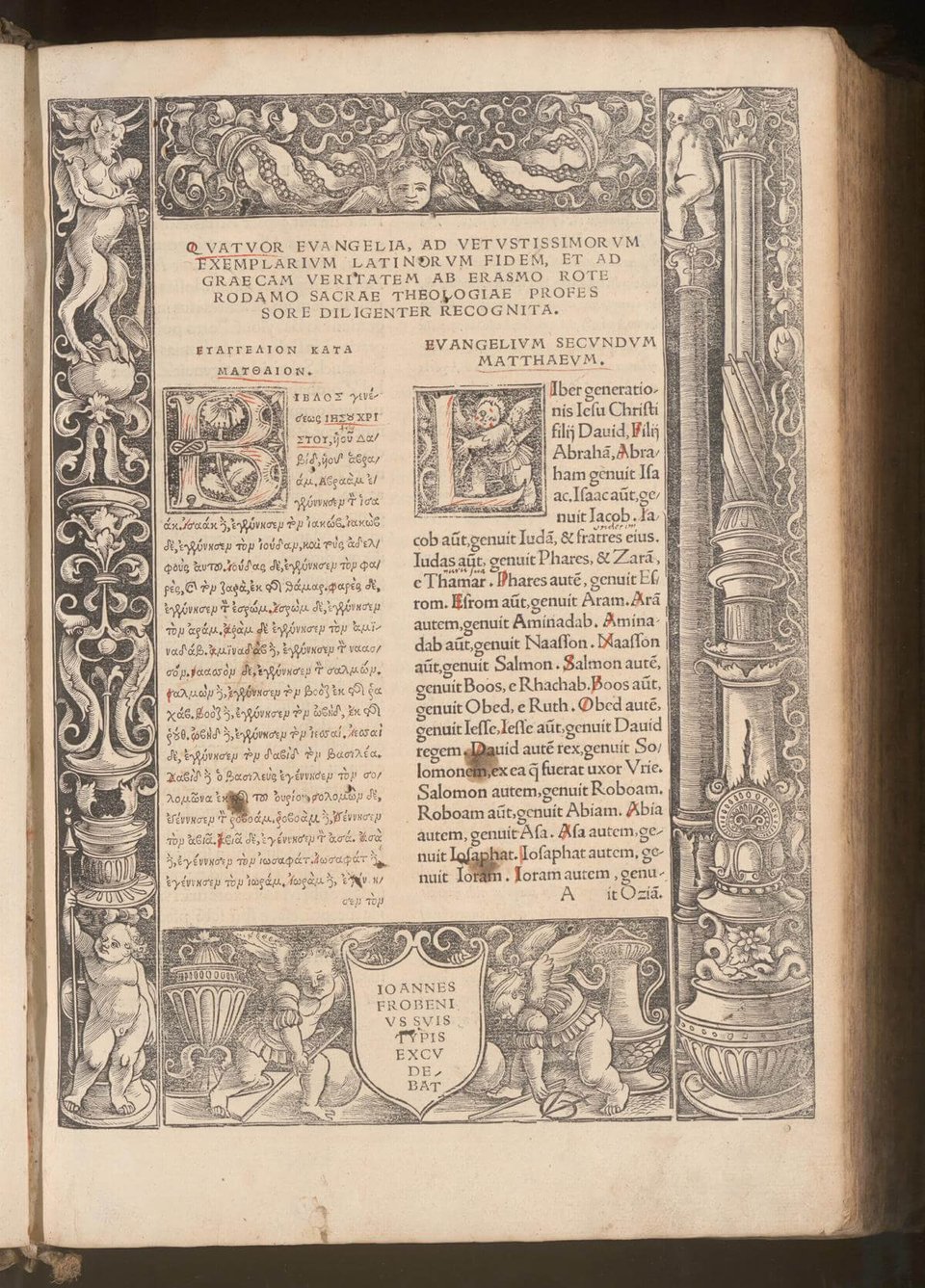
Novum Instrumentum omne (Basel: Froben, 1516), sig. A1r, the opening of Matthew. Universitätsbibliothek Basel, BibG B 3; image via Early Printed Books (Sarah Werner) · Public domain

Plate II.5

Erasmus’s Novum Instrumentum: the first published Greek New Testament

Date
1516 (Basel: Johann Froben; finished 1 March 1516)
Held at
Universitätsbibliothek Basel (BibG B 3)

The opening of the Gospel of Matthew in the first Greek New Testament ever published, edited by Desiderius Erasmus and printed by Johann Froben at Basel. The Greek stands in the left column and Erasmus’s Latin in the right, inside a woodcut border signed by the printer.

Erasmus first visited Basel in August 1514, where he met the printer Johann Froben, and returned to work there in July 1515. Printing began on 2 October 1515 and was finished on 1 March 1516. The volume was dedicated to Pope Leo X. Spain’s Complutensian Polyglot had already printed its Greek New Testament in 1514, but that was not released until 1522, so Erasmus’s edition was the first to be published. For the Gospels Erasmus sent to the press a Greek manuscript borrowed from the Dominican friars of Basel, Minuscule 2, shown just before this plate in the Gallery, after correcting it against the other manuscripts he had. The work was hurried, and Erasmus himself later called the first edition “precipitated rather than published” (praecipitatum verius quam editum). Many of its slips were corrected in the editions that followed. The heading on this page says the four Gospels were “diligently revised” by Erasmus, and the shield at the foot reads “Ioannes Frobenius suis typis excudebat”, that is, Johann Froben printed it with his types. Through Erasmus’s later editions, and the editions of Stephanus that built on them, this Greek text became the basis of the Received Text. Luther, Tyndale and the translators of our King James Version all translated their New Testaments from that text.

“The book of the generation of Jesus Christ, the son of David, the son of Abraham.”

Source en.wikipedia.org — Wikipedia, “Novum Instrumentum omne” (citing B. M. Metzger, H. J. de Jonge and E. Rummel); SMU Bridwell Library, “The First Published New Testament in Greek” (BRA2476). Image: Universitätsbibliothek Basel, BibG B 3, public domain, via Early Printed Books. Matt 1:1 KJV verified.

Tyndale’s New Testament (Peter Schöffer, 1526), the first page of John. British Library, via Wikimedia Commons · Public domain

Plate II.6

Tyndale’s New Testament: the Gospel of John

Date
1526
Held at
The British Library, London

The first complete New Testament printed in English, translated from the Greek by William Tyndale. Thousands of copies were smuggled into England, and only three are known to survive.

Tyndale began his translation in 1522, working from Erasmus’s Greek text with Luther’s German and the Latin Vulgate beside him. The Bishop of London refused to support the work, so Tyndale left England. A partial edition begun at Cologne in 1525 was interrupted, and the first complete edition was printed in 1526 by Peter Schöffer the Younger. The Bishop of London ordered copies to be bought up and burned. Of the thousands smuggled into England, three are known to survive: at St Paul’s Cathedral, at the British Library, and at the Württemberg State Library in Stuttgart. Tyndale was arrested in 1535 and put to death in 1536. His translation is reflected in the King James Version that followed. The British Library’s copy, from which this page is shown, passed through Baptist hands. It is complete apart from its title page and is illuminated throughout. Its recorded owners begin with Edward Harley, 2nd Earl of Oxford (died 1741). In 1743 the antiquary Joseph Ames bought it, calling it “a Phoenix of the whole library”. At Ames’s sale in 1760 it went to John White, who on 13 May 1776 sold it for 20 guineas to Andrew Gifford, pastor of the Baptist meeting in Eagle Street, London. Gifford left his library to the Baptist academy at Bristol, which trained ministers, and the Testament reached Bristol in the autumn of 1784. It stayed at Bristol Baptist College for 210 years, until a sale to the British Library was agreed on 21 April 1994.

“In the beginning was the Word, and the Word was with God, and the Word was God.”

Source en.wikipedia.org — Wikipedia, “Tyndale Bible” (sources, the Cologne fragment, the 1526 edition, the burning of copies, the three surviving copies, arrest and death). Provenance of the British Library (ex-Bristol) copy: M. West, “The Bristol 1526 Tyndale Testament – its Origin and its History,” Reformation 1 (1996) 113–17, tyndale.org (Ames’s 1743 letter, White’s inscription, Gifford’s bequest, the 1994 sale). Not claimed: the Anne Boleyn tradition; the 1994 price.

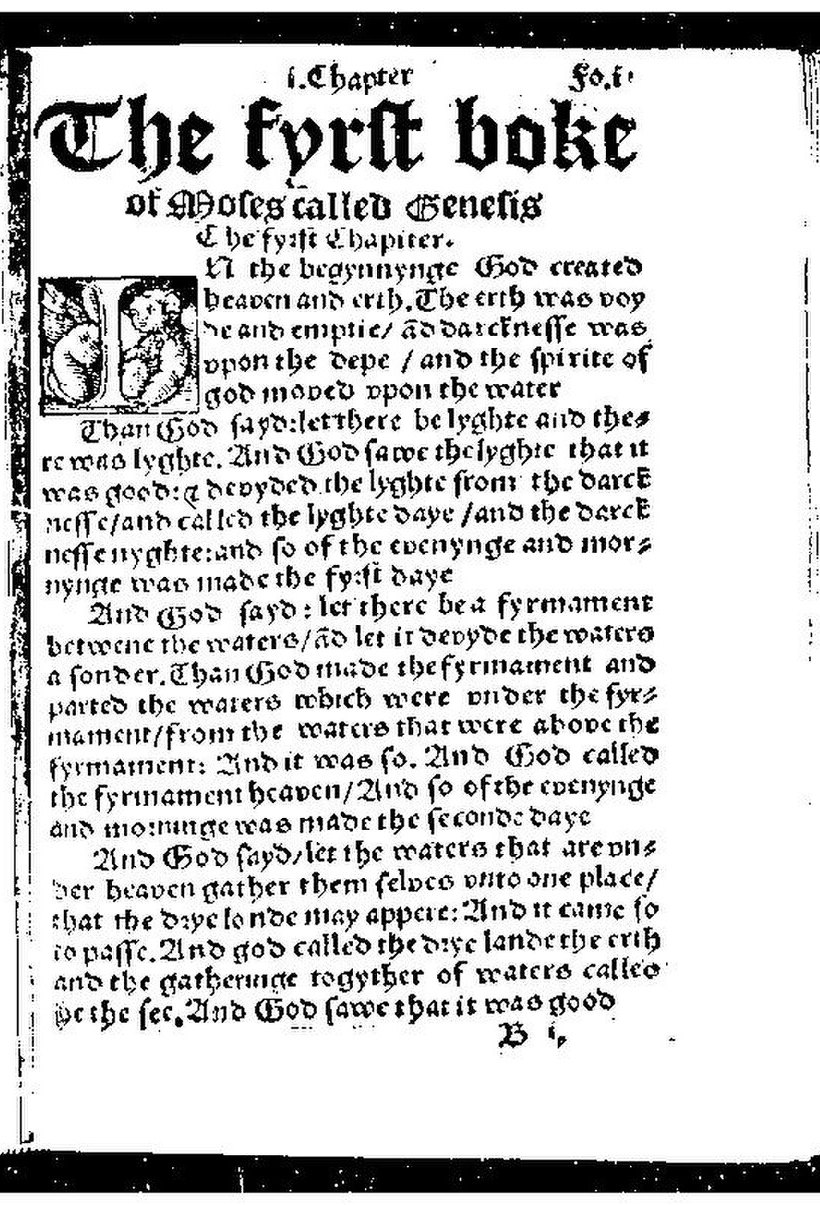
Tyndale’s Pentateuch (1530), folio i, Genesis 1. Cambridge University Library copy (Internet Archive item ThePentateuch), via Wikimedia Commons; cropped to the leaf · Public domain

Plate II.7

Tyndale’s Pentateuch: “In the begynnynge”

Date
1530
Held at
Cambridge University Library (STC 2350), as digitised on the Internet Archive

Folio i of “The fyrst boke of Moses called Genesis”. Beneath a woodcut initial I, the first English Genesis translated from the Hebrew begins: “In the begynnynge God created heaven and erth.” A few lines on comes verse 3: “Than God sayd: let there be lyghte and there was lyghte.” The page carries the chapter to the gathering of the waters and the dry land, and ends with “And God sawe that it was good”.

William Tyndale’s translation is credited as the first English Bible text to work directly from the Greek and, for the five books of Moses, from the Hebrew. His New Testament had come out in 1526. His Pentateuch followed in 1530, printed at Antwerp, and its colophon hides the place behind a false imprint: “Imprented at Malborow in the lande of Hesse … By me Hans Luft”, dated 17 January 1530. Cataloguers differ over the real printer. The Cambridge record names Johan Hoochstraten, and other accounts give Merten de Keyser with Joannes Grapheus. Tyndale’s Jonah followed in 1531 and a revised Genesis in 1534. He also translated Joshua to 2 Chronicles, but those books were not printed until John Rogers set them in the Matthew Bible of 1537. Tyndale never published a whole Bible in English. He was arrested at Antwerp in 1535 and put to death at Vilvoorde in 1536. His Pentateuch is shown here as the Cambridge copy was scanned.

“In the beginning God created the heaven and the earth. … And God said, Let there be light: and there was light.”

Source en.wikipedia.org — Wikipedia, “Tyndale Bible” (from the Hebrew; Antwerp 1530, de Keyser and Grapheus; Jonah 1531; Genesis revised 1534; Joshua–Chronicles in the Matthew Bible; arrest 1535, death 1536). The imprint, the date and the Hoochstraten attribution come from the Internet Archive record of the Cambridge copy. The 1530 wording was read from the plate itself.

The Coverdale Bible (1535), Ephesians 5–6 and the opening of Philippians. Internet Archive item CoverdaleBible1535_838, via Wikimedia Commons · Public domain

Plate II.8

The Coverdale Bible of 1535: the whole armour of God

Date
1535 (first printed 4 October 1535)
Held at
A digitised copy on the Internet Archive (the holding library is not recorded)

The first complete Bible printed in English. On the left-hand page, in the right-hand column, Paul’s charge of Ephesians 6 stands as the first English readers of a whole printed Bible met it: “Aboue all thinges take holde of the shylde of faith, wherwith ye maye quenche all the fyrie dartes of the wicked. And take the helmet of saluacion, & the swerde of the sprete, which is the worde of God.”

Myles Coverdale’s Bible was first printed on 4 October 1535. Where it was printed was long disputed, until in 1997 Guido Latré identified the printer as Merten de Keyser of Antwerp. Coverdale was not a Hebrew or Greek scholar. For the New Testament he followed William Tyndale’s translation, and for the Old he used Tyndale’s published Pentateuch and translated the remaining books himself, working chiefly from the German Bibles of Luther and of Zürich and from Latin sources, the Vulgate among them. Editions of 1537 were the first complete Bibles printed in England, and the 1537 folio carried the royal licence. Coverdale went on to prepare the Great Bible of 1539, and his Psalter passed into the Great Bible of 1540 and into the Book of Common Prayer of 1662. On the facing page Ephesians ends with its printed subscription, “Sent from Rome vnto the Ephesians, by Tichicus”, and the Epistle to the Philippians begins, with a woodcut of a figure writing at a desk.

“Above all, taking the shield of faith, wherewith ye shall be able to quench all the fiery darts of the wicked.”

Source en.wikipedia.org — Wikipedia, “Coverdale Bible” (first printed 4 October 1535; Latré 1997 and Merten de Keyser; Coverdale’s sources: Tyndale, Luther and the Zürich Bible, the Vulgate; the 1537 editions and royal licence; the Psalter in the Great Bible of 1540 and the 1662 Book of Common Prayer). The quoted 1535 wording and the page contents were read from the plate itself (djvu page 541).

The Matthew Bible (1537), Ephesians 6 and the opening of Philippians. Internet Archive item MatthewBible1537, via Wikimedia Commons · Public domain

Plate II.9

The Matthew Bible of 1537: loins girt with truth

Date
1537
Held at
A digitised copy on the Internet Archive (the holding library is not recorded)

Tyndale’s New Testament, as it went out under the king’s licence. At the top of the left-hand page Paul’s charge of Ephesians 6 continues from verse 11; verse 14 reads: “Stande therfore, and youre loynes gyrd aboute wyth verytye, hauynge on the brest plate of ryghtewesnes.” Beneath the chapter’s close comes its subscription, “Sent from Rome vnto the Ephesyans by Tichicus”, and the Epistle to the Philippians begins.

The Matthew Bible was published in 1537 by John Rogers under the name “Thomas Matthew”. It joined the work of William Tyndale, who had been put to death at Vilvoorde on 6 October 1536, to that of Myles Coverdale. Its whole New Testament, Tyndale’s translation of 1526 as he revised it in 1534, came from Tyndale, with the Pentateuch, Jonah and, in David Daniell’s view, Joshua to 2 Chronicles; Tyndale worked directly from the Hebrew and the Greek. Coverdale’s translation supplied the rest of the Old Testament and the Apocrypha, and Rogers added the Prayer of Manasseh, a preface and marginal notes. Accounts of where it was printed differ: Paris and Antwerp, by Jacobus van Meteren, or Hamburg, as John Strype wrote in 1694. Richard Grafton had leave to sell the edition of 1,500 copies in England, and at Archbishop Cranmer’s insistence it received “the King’s most gracious license”. A. S. Herbert, the Bible cataloguer, called it “the real primary version of our English Bible”, on which later editions, the Geneva Bible and the King James Version among them, were based. John Rogers was burned at Smithfield on 4 February 1555, the first to die so under Mary I.

“Stand therefore, having your loins girt about with truth, and having on the breastplate of righteousness;”

Source en.wikipedia.org — Wikipedia, “Matthew Bible” (Rogers as “Thomas Matthew”; Tyndale’s and Coverdale’s shares; Daniell; Strype on Hamburg; Herbert) and “John Rogers (Bible editor and martyr)” (Paris and Antwerp; Grafton, 1,500 copies; Cranmer and the licence; 4 February 1555). The 1537 wording was read from the plate itself (djvu page 525).

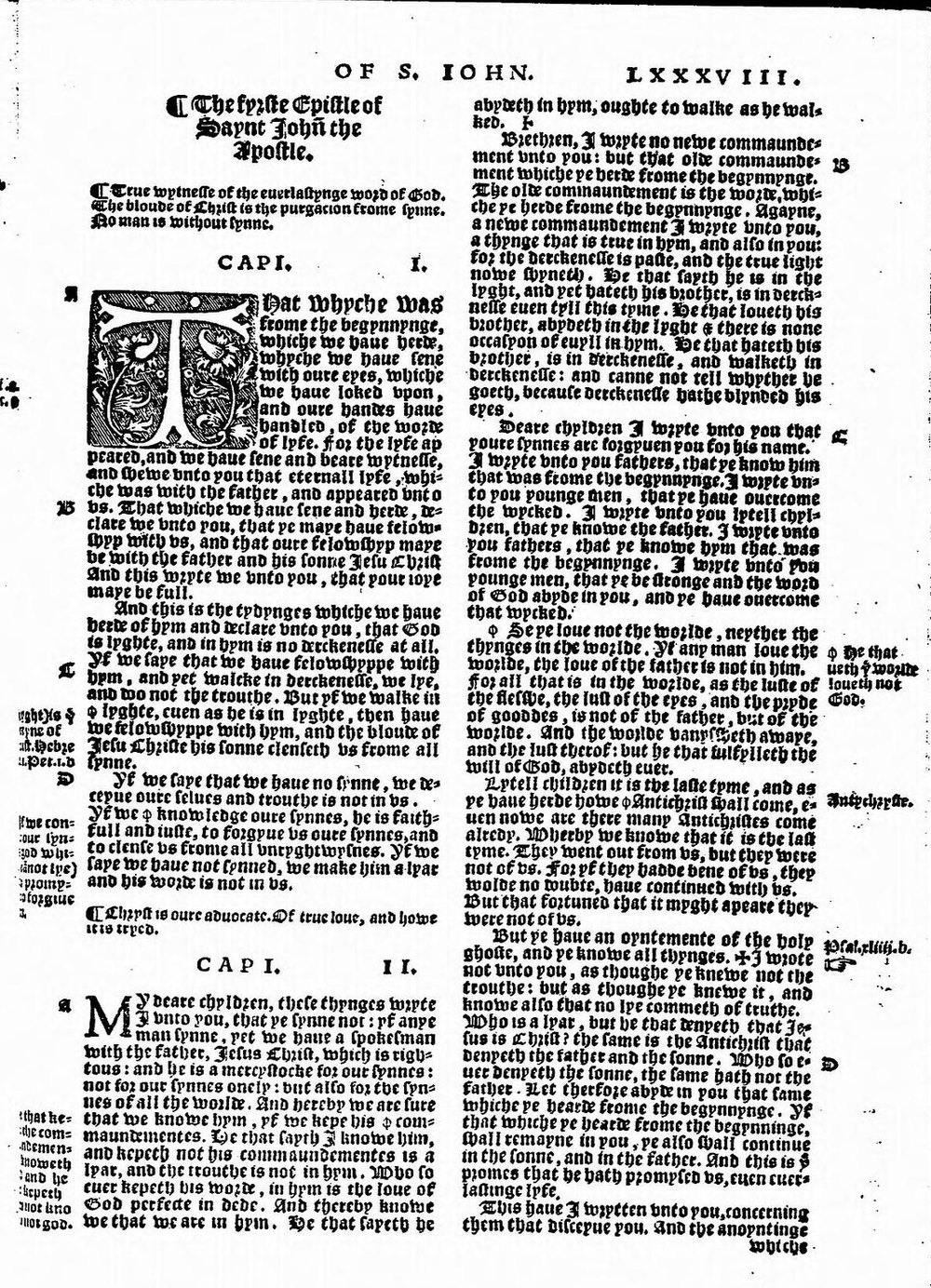
Taverner’s Bible (1539), fol. LXXXVIII, the opening of 1 John. Internet Archive item 1539TavernerBible (Public Domain Mark 1.0), via Wikimedia Commons; cropped to the leaf · Public domain

Plate II.10

Taverner’s Bible of 1539: “a spokesman with the father”

Date
1539
Held at
A digitised copy on the Internet Archive (the holding library is not recorded)

The leaf numbered LXXXVIII, where “The fyrste Epistle of Saynt Iohn the Apostle” begins. The summary over chapter 2 says “Chryst is oure aduocate”, but in the verse itself Taverner set an English word in place of the Latin one: “yf anye man synne, yet we haue a spokesman with the father, Iesus Christ, which is rightous: and he is a mercystocke for our synnes”.

Richard Taverner (1505–1575), a lawyer of the Inner Temple with a name as a Greek scholar, revised the Matthew Bible for a rival folio printed in London in 1539, the year of the Great Bible, by “John Byddell for Thomas Barthlet”. The 1911 Encyclopaedia Britannica calls him “perhaps, the first purist among the Biblical translators, endeavouring, whenever possible, to substitute a word of native origin for the foreign expression of his predecessors.” His Greek was stronger than his Hebrew, and his New Testament is reckoned the better half. B. F. Westcott wrote in 1872 that “his New Testament at least deserves more attention than has yet been paid to it”, and he pointed to this page: “All the other versions adopt the Latin ‘advocate’ in 1 John ii. 1, for which Taverner substitutes the Saxon ‘spokesman’”, and in the next verse “Taverner boldly coins a word which if insufficient is yet worthy of notice”: mercystocke, for the propitiation. The fall of Thomas Cromwell in 1540 ended Taverner’s literary work. His revision had little influence on later translators, though a few phrases in the King James Bible can be traced to it. Here the King James translators kept advocate and propitiation.

“My little children, these things write I unto you, that ye sin not. And if any man sin, we have an advocate with the Father, Jesus Christ the righteous: And he is the propitiation for our sins: and not for ours only, but also for the sins of the whole world.”

Source en.wikipedia.org — Wikipedia, “Taverner’s Bible” (Byddell for Barthlet; influence) and “Richard Taverner” (dates; Inner Temple; Greek and Hebrew; Cromwell). Encyclopaedia Britannica (1911), “Bible, English”. B. F. Westcott, A General View of the History of the English Bible (2nd ed., 1872), pp. 215–217. The 1539 wording was read from the plate itself (djvu page 501).

The Great Bible, displayed at the British Library as Henry VIII’s copy (London, 1540). Photograph by Daderot, 2024, via Wikimedia Commons · CC0

Plate II.11

The Great Bible: the opening of Romans

Date
1540 (London; first edition 1539)
Held at
The British Library, London

The first English Bible authorised by the Crown to be read in the churches. This copy lies open where the Acts of the Apostles ends and the Epistle to the Romans begins, its first letter painted in blue and gold. The British Library displays it as Henry VIII’s copy, printed in London in 1540 and later owned by Elizabeth I.

The Great Bible was prepared by Myles Coverdale under a commission from Thomas Cromwell, and takes its name from its size. In 1538 Cromwell directed the clergy to set up “one book of the Bible of the largest volume in English” in every church, where parishioners could come and read it; copies were often chained so they could not be carried away. Coverdale based it on Tyndale’s work, and added to the New Testament a number of phrases found only in the Latin Vulgate; the Old Testament books Tyndale had not reached were translated from the Vulgate and German versions rather than from the Hebrew. Printing began in Paris in 1539 and was finished in London. The second edition of April 1540 carried a preface by Archbishop Thomas Cranmer recommending the reading of the Scriptures, and more than 9,000 copies had been printed by 1541. In 1568 the Bishops’ Bible superseded it as the Church of England’s authorised Bible.

“For I am not ashamed of the gospel of Christ: for it is the power of God unto salvation to every one that believeth; to the Jew first, and also to the Greek.”

Source en.wikipedia.org — Wikipedia, “Great Bible” (Cromwell’s 1538 injunction, the chained Bible, sources, Paris and London printing, Cranmer’s 1540 preface, 9,000 copies by 1541, 1568). The BL display wording (“Henry VIII’s copy… London, 1540… later owned by Elizabeth I”) per the Commons file and a second visitor’s photograph (Flickr, 2023). No claim about vellum: the Fitzwilliam Museum places the vellum presentation copies at St John’s, Cambridge and the National Library of Wales.

Robert Estienne’s Greek New Testament (Paris, 1550), the opening of John. Digitised by Bridwell Library, SMU, via Wikimedia Commons · Public domain

Plate II.12

Stephanus’s Editio Regia: the Gospel of John

Date
1550 (Paris)
Held at
Bridwell Library, Perkins School of Theology, Southern Methodist University

The “Royal Edition” of the Greek New Testament, printed in Paris in 1550 by Robert Estienne (Stephanus) in the king’s Greek type cut by Claude Garamond. It became one of the two standard forms of the Received Text.

Robert Estienne, printer to the King of France, edited the Greek New Testament four times, in 1546, 1549, 1550 and 1551. The third edition, the Editio Regia, was published for King Henri II. It drew on more than fifteen Greek sources, which are noted in its margins, and it was set in the grecs du roi, the royal Greek types cut by Claude Garamond. Opposed by the theologians of the Sorbonne, Estienne left Paris for Geneva around 1550. In his Geneva edition of 1551 he divided the New Testament into numbered verses for the first time. His text, together with Theodore Beza’s editions built upon it, became the standard Received Text, and the King James translators drew on both.

“And the Word was made flesh, and dwelt among us, (and we beheld his glory, the glory as of the only begotten of the Father,) full of grace and truth.”

Source en.wikipedia.org — Wikipedia, “Robert Estienne” (the four editions, the Editio Regia, Garamond’s type, Geneva, verse numbering in 1551); “Textus Receptus” (Stephanus and Beza as the standard texts; the KJV translators’ use of Erasmus, Stephanus and Beza). Type and page per the Commons file record.

The Geneva Bible (1560), Genesis 2–3 with the woodcut map of Eden. Houghton Library, Harvard University, STC 2093, via Wikimedia Commons · Public domain

Plate II.13

The Geneva Bible of 1560: Genesis and the garden of Eden

Date
1560 (Geneva)
Held at
Houghton Library, Harvard University (STC 2093)

The first complete English Bible translated throughout from the Hebrew and Greek, made by English Protestant exiles at Geneva and printed in easy-to-read Roman type. This page carries a woodcut map of the situation of Eden, and the chapter in which Adam and Eve make themselves “breeches”.

When Mary I restored Catholicism in England, a number of English Protestant scholars took refuge in Geneva. There William Whittingham oversaw a new translation, with Myles Coverdale among his colleagues. Their New Testament appeared in 1557 and the whole Bible in 1560. Resting heavily on Tyndale’s work, and issued in convenient sizes, it became the chief Bible of English Protestants in the later sixteenth century. It went through more than 150 editions, was used by Shakespeare, John Knox and John Donne, and crossed the Atlantic on the Mayflower. Its marginal notes were Calvinist, and King James disliked them. The King James Version was made partly to replace it, yet its translators drew heavily on the Geneva wording. The nickname “Breeches Bible” comes from Genesis 3:7 on this very page, where the King James Version reads “aprons”.

“And the eyes of them both were opened, and they knew that they were naked; and they sewed fig leaves together, and made themselves aprons.”

Source en.wikipedia.org — Wikipedia, “Geneva Bible” (the Marian exiles, Whittingham and Coverdale, 1557 and 1560, Roman type, editions, the Mayflower, the Calvinist notes and King James, reliance by the KJV translators, “Breeches Bible”). Page contents per the Houghton Library description on the Commons file record.

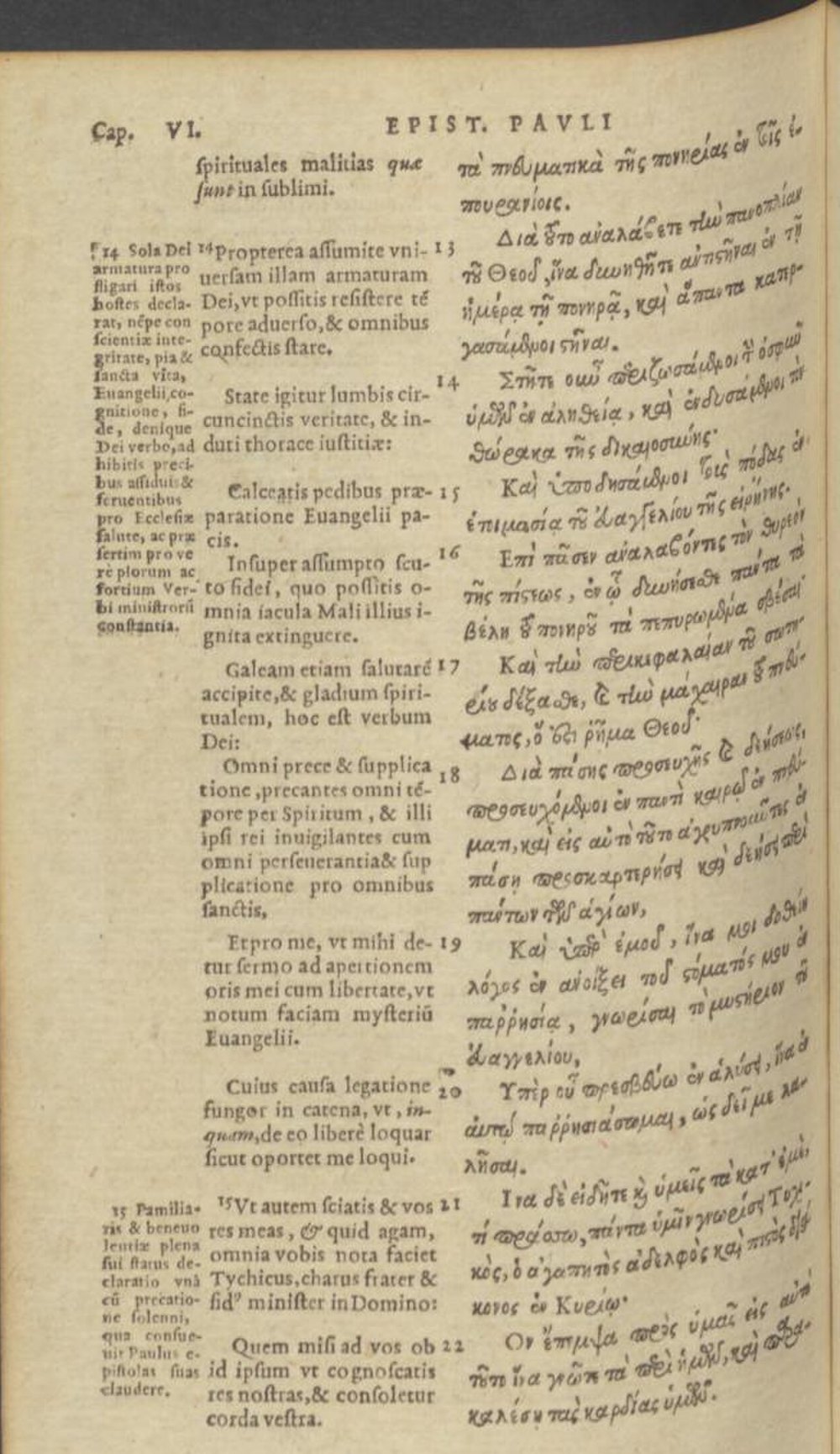
Beza, Novum Testamentum Græce & Latine (Geneva: H. Estienne, 1565), fol. 305v, Ephesians 6. Biblioteka Uniwersytecka KUL, Lublin (P.XVI.502), via Internet Archive and Wikimedia Commons; cropped to the leaf · Public domain

Plate II.14

Beza’s Greek and Latin New Testament: “the whole armour of God” in 1565

Date
1565 (Geneva: Henri Estienne)
Held at
Biblioteka Uniwersytecka KUL, Lublin (P.XVI.502)

Leaf 305 verso, Ephesians 6 from the end of verse 12 to verse 22: the Greek on the right, Theodore Beza’s own Latin on the left. Verse 14 reads “State igitur lumbis circuncinctis veritate, & induti thorace iustitiæ”. Beza’s marginal note begins “Sola Dei armatura profligari istos hostes declarat, nempe conscientiæ integritate, pia & sancta vita, Euangelii cognitione, fide, denique Dei verbo …”.

Theodore Beza (1519–1605), born at Vézelay in Burgundy, succeeded John Calvin as the spiritual leader of Geneva. In 1565 he issued his first edition of the Greek New Testament, and that same year Henri Estienne printed this small octavo at Geneva, setting the Greek beside Beza’s own Latin translation. For the Greek, Beza leaned chiefly on the 1550 edition of Henri’s father, Robert Estienne (Stephanus), which hangs earlier in this room. He had two ancient manuscripts in hand, the Codex Bezae, which he gave to Cambridge in 1581, and the Codex Claromontanus, but made little use of them. Revised editions followed in 1582, 1588–89 and 1598, and with Stephanus’s his text became one of the two standard forms of the Received Text. The King James translators drew on Erasmus, Stephanus and Beza. The 1911 Encyclopaedia Britannica says: “His editions and Latin versions of the New Testament had a marked influence on the English versions of Geneva (1557 and 1560) and London (1611).” The margin beside verse 14, in the museum’s own rendering, says that these foes are routed by the armour of God alone: by integrity of conscience, a godly and holy life, knowledge of the Gospel, faith, and lastly the Word of God.

“Stand therefore, having your loins girt about with truth, and having on the breastplate of righteousness; And your feet shod with the preparation of the gospel of peace; Above all, taking the shield of faith, wherewith ye shall be able to quench all the fiery darts of the wicked. And take the helmet of salvation, and the sword of the Spirit, which is the word of God:”

Source en.wikipedia.org — Wikipedia, “Theodore Beza” (life; the 1565 edition; Estienne 1550; Codex Bezae and Claromontanus) “Textus Receptus” (later editions; KJV) and “Henri Estienne”. Encyclopaedia Britannica (1911), “Beza, Theodore”. KUL dLibra record 43666 (imprint, format, public domain). The 1565 Latin was read from the plate.

The Bishops’ Bible (Richard Jugge, London, 1569), the title page, printed on vellum and coloured. British Library G.12188, via Wikimedia Commons · CC0

Plate II.15

The Bishops’ Bible: the title page of 1569

Date
1569 (London; first edition 1568)
Held at
The British Library, London (G.12188)

The Church of England’s own Bible, made under Matthew Parker, Archbishop of Canterbury. On this title page, printed on vellum and coloured by hand, Queen Elizabeth sits enthroned between Justice and Mercy.

The bishops of the Church of England wanted an English Bible for the churches without the Calvinist notes of the Geneva Bible. Archbishop Parker divided the work among his fellow bishops, and in the early editions each section ends with its translator’s initials. The Bible was first published in 1568 and extensively revised in 1572; this copy, printed in London by Richard Jugge, is dated 1569. It was meant to be read aloud from the pulpit, and it went through more than 50 editions. When the King James Version was begun, its translators were instructed to take the 1602 edition of the Bishops’ Bible as their basis, weighing the other English translations beside it. It is also called the “Treacle Bible”, from its rendering of Jeremiah 8:22, “Is there not treacle at Gilead?”, where the King James Version reads “balm”.

“Is there no balm in Gilead; is there no physician there? why then is not the health of the daughter of my people recovered?”

Source en.wikipedia.org — Wikipedia, “Bishops’ Bible” (Parker and the bishops’ initials, 1568 and 1572, pulpit use, editions, the 1602 edition as the KJV’s base text, “Treacle Bible”). Printer, date, shelfmark and the vellum title page per the British Library record on the Commons file.

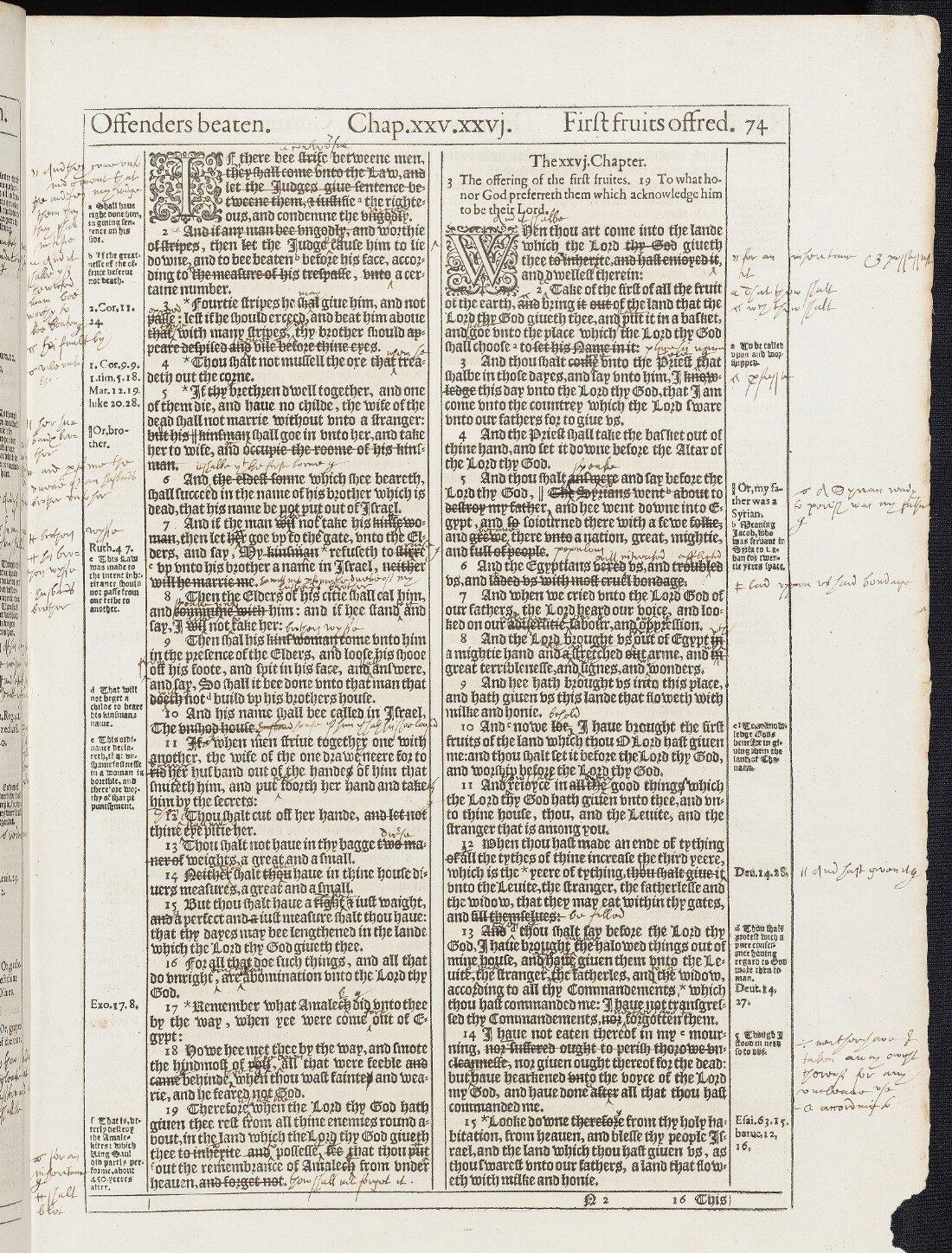
Bodleian Library Arch. A b.18, fol. N2r (Deuteronomy 25–26). Photo: © Bodleian Libraries, University of Oxford, via Digital Bodleian; cropped to the leaf · CC BY-NC 4.0

Plate II.16

The translators’ own sheets: the 1602 Bishops’ Bible, marked for the King James

Date
1602 (London: Robert Barker)
Held at
Bodleian Library, University of Oxford (Arch. A b.18)

Folio N2r, Deuteronomy 25–26, with a translator’s pen at work. In Deuteronomy 26:5 the printed words “The Syrians went about to destroy my father” are struck through, and the margin supplies the reading the King James Bible prints: “A Syrian ready to perish was my father”. Beside them, “answere” becomes “speake” and “full of people” becomes “populous”. In verse 6, “laded vs with most cruel bondage” is struck, and the margin gives the King James words, “laid upon us hard bondage”.

The Bishops’ Bible was first issued in 1568 and revised in 1572 as the Church of England’s pulpit Bible, and the King James translators were instructed to take its 1602 edition as their basis. The Bodleian records that forty unbound copies of that edition were given to the translators at the start of the work. The only sheets known to survive from them are bound together in this copy, which the Library described on acquiring it as “a large Bible wherein is written downe all the Alterations of the last Translacion”. The annotations fall in parts of the Old and New Testaments and, in the Library’s words, “reflect the work-in-progress of four of the six translating companies”. The page shows what the translators said of their own aim in their 1611 preface: not to make a new translation, but “to make a good one better”. The leaf is shown as the Bodleian photographed it, cropped to the page.

“And thou shalt speak and say before the LORD thy God, A Syrian ready to perish was my father, and he went down into Egypt, and sojourned there with a few, and became there a nation, great, mighty, and populous: And the Egyptians evil entreated us, and afflicted us, and laid upon us hard bondage:”

Source digital.bodleian.ox.ac.uk — The Bodleian’s exhibition captions for this copy (2011, 2019) in its Digital Bodleian record; Wikipedia, “Bishops’ Bible”; the 1611 preface, “The Translators to the Reader”. Shown free of charge under CC BY-NC 4.0 (non-commercial). A copy is on Wikimedia Commons (Bodleian-Library-Arch-A-b-18 00189 fol-N2r.jpg), tagged CC BY 4.0 there; the Bodleian’s terms govern. The struck and added words were read from the plate itself.

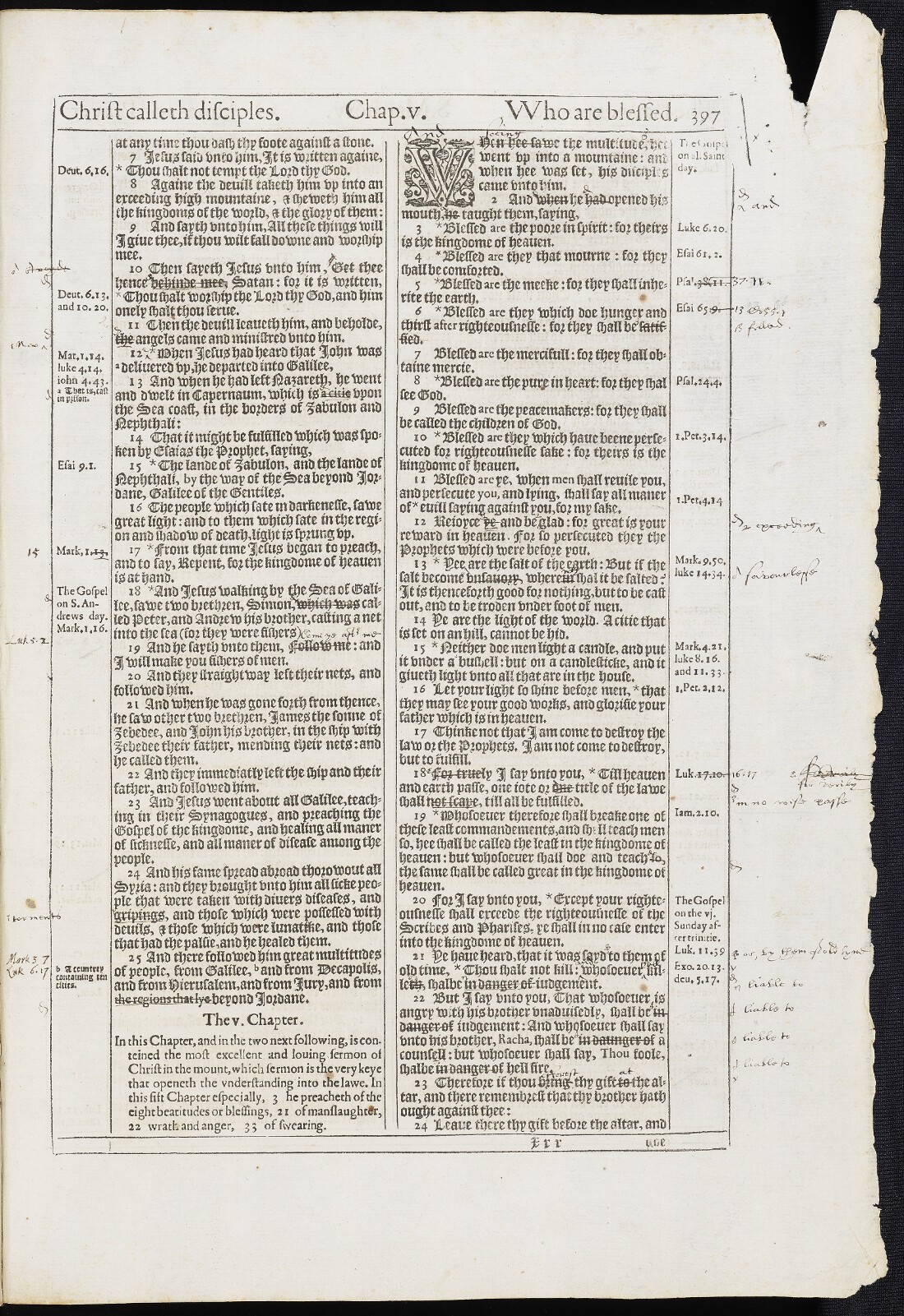
Bodleian Library Arch. A b.18, fol. Xxx1r (Matthew 4–5). Photo: © Bodleian Libraries, University of Oxford, via Digital Bodleian; cropped to the leaf · CC BY-NC 4.0

Plate II.17

The translators’ own sheets, II: the Beatitudes under the pen

Date
1602 (London: Robert Barker)
Held at
Bodleian Library, University of Oxford (Arch. A b.18)

Folio Xxx1r (printed folio 397), Matthew 4–5: the opening of the Sermon on the Mount, with a translator’s pen at work. “When hee sawe” is struck and “And seeing” written above. In verse 2 “when”, “had” and the second “he” are struck, leaving “And he opened his mouth, and taught them”. In verse 6 “satisfied” is struck and the margin gives “filled”. In verse 12 “ye” is struck and “exceeding” is added.

This is a second leaf from the same copy as the Deuteronomy sheet beside it: the surviving pages of the 1602 Bishops’ Bibles that were given to the King James translators to mark. Here the work falls on some of the most familiar words of Christ in English. Every change named above is exactly what the 1611 Bible prints. Not every pen-stroke was final, though. In verse 13 the printed “unsavory” is struck and a different word is written in the margin, but the 1611 text reads instead “if the salt have lost his savour”. The sheet shows a translation still being weighed, word by word, before it was settled. The leaf is shown as the Bodleian photographed it, cropped to the page.

“And seeing the multitudes, he went up into a mountain: and when he was set, his disciples came unto him: And he opened his mouth, and taught them, saying, … Blessed are they which do hunger and thirst after righteousness: for they shall be filled. … Rejoice, and be exceeding glad: for great is your reward in heaven: for so persecuted they the prophets which were before you.”

Source digital.bodleian.ox.ac.uk — The Bodleian’s Digital Bodleian record for this copy (with its exhibition captions of 2011 and 2019). The struck and added words were read from the plate itself and checked against the 1611 text of Matthew 5. Shown free of charge under CC BY-NC 4.0 (non-commercial); the Bodleian’s terms govern.

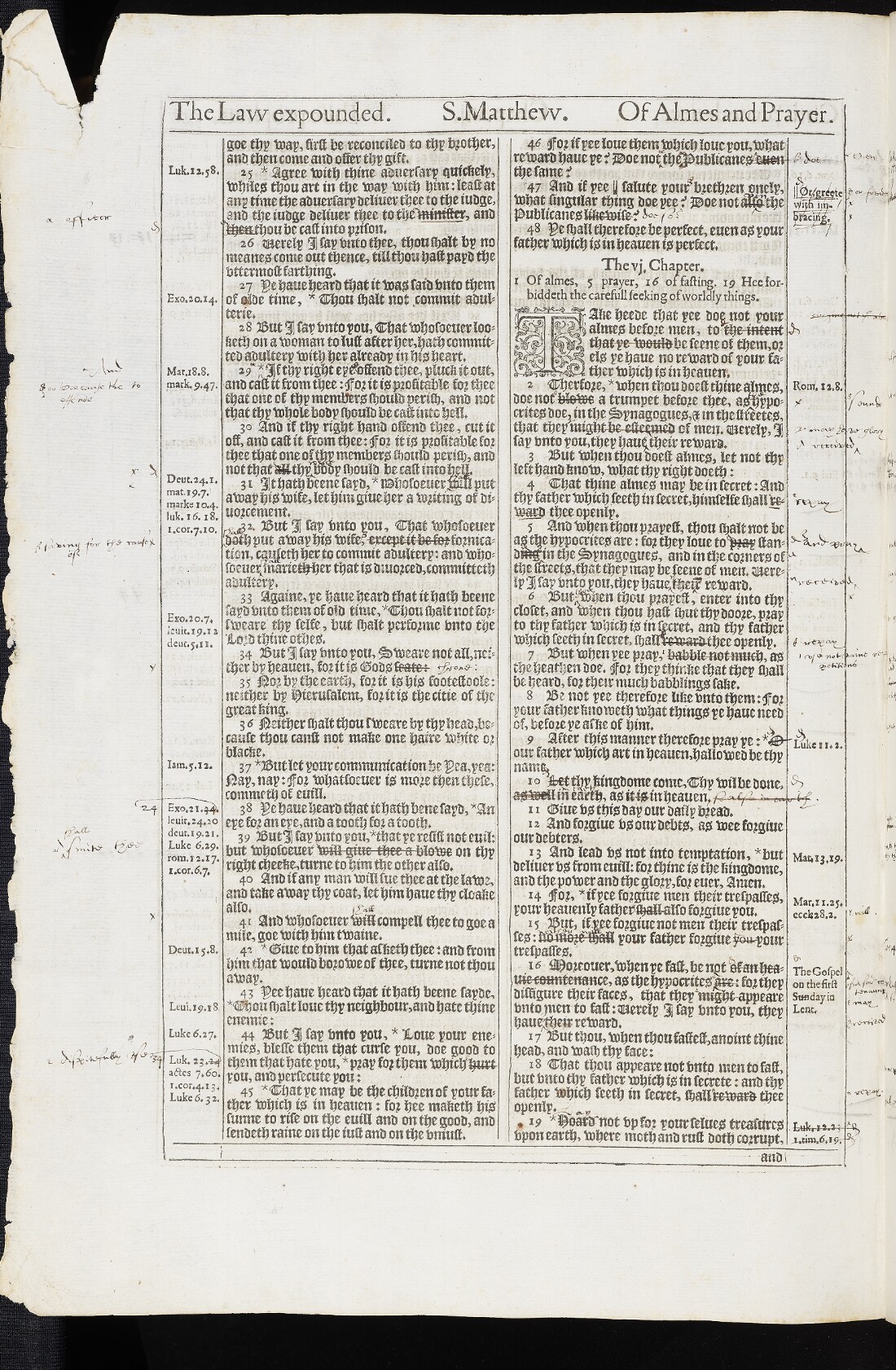
Bodleian Library Arch. A b.18, fol. Xxx1v (Matthew 5–6). Photo: © Bodleian Libraries, University of Oxford, via Digital Bodleian; cropped to the leaf · CC BY-NC 4.0

Plate II.18

The translators’ own sheets, III: the Lord’s Prayer

Date
1602 (London: Robert Barker)
Held at
Bodleian Library, University of Oxford (Arch. A b.18)

Folio Xxx1v, Matthew 5–6, headed “Of Almes and Prayer”. In verse 9 the printed “O” before “our father” is struck through. In verse 10 “Let” is struck before “thy kingdome come”, and “as well” is struck before “in earth”. What is left is the prayer as the 1611 Bible prints it.

This leaf follows the Beatitudes in the same copy: one of the 1602 Bishops’ Bibles given to the King James translators to mark. The Bishops’ text read “O our father which art in heauen” and “Let thy kingdome come … as well in earth, as it is in heauen”. Three strokes of the pen bring it to the words generations have prayed since: “Our Father which art in heaven … Thy kingdom come. Thy will be done in earth, as it is in heaven.” There are further marks in verse 10, and a struck draft in the margin; they are not certainly legible and are not transcribed here. The leaf is shown as the Bodleian photographed it, cropped to the page.

“After this manner therefore pray ye: Our Father which art in heaven, Hallowed be thy name. Thy kingdom come. Thy will be done in earth, as it is in heaven.”

Source digital.bodleian.ox.ac.uk — The Bodleian’s Digital Bodleian record for this copy (with its exhibition captions of 2011 and 2019). The printed and struck words were read from the plate itself and checked against the 1611 text of Matthew 6. Shown free of charge under CC BY-NC 4.0 (non-commercial); the Bodleian’s terms govern.

The first page of Genesis from the original 1611 printing of the King James Bible. Via Wikimedia Commons · Public domain

Plate II.19

The King James Bible of 1611: Genesis 1

Date
1611 (London)

The first page of Genesis in the first printing of the Authorised Version, issued as a large folio by Robert Barker, the King’s Printer.

The translation was commissioned in 1604 and carried out by 47 scholars in six companies, two each at Oxford, Cambridge and Westminster. For the Old Testament they used the Hebrew text of Daniel Bomberg’s printed Rabbinic Bible (1524–25). For the New Testament they used the Received Text in the editions of Erasmus, Stephanus and Beza, and consulted the Complutensian Polyglot as well. Robert Barker, the King’s Printer, issued it in 1611 as a folio for reading in churches, sold unbound for ten shillings or bound for twelve. It was printed in heavy black-letter type, and the translators’ rules required that words they supplied in English to complete the sense be set in a different type, as can be seen on this page. Its spelling was standardised in later editions, most notably the Oxford edition of 1769. On 12 November 1865, at Cornwall Road Chapel, Bayswater, the Baptist C. H. Spurgeon took the opening verses of this page as his text (sermon No. 660, “Light, Natural and Spiritual”). He began by calling the chapter “a literal and accurate account of God’s first day’s work in the creation of the world”, and on the words “Let there be light” he said: “This divine work is wrought by the Word. … So the way in which we receive light is by the Word of God.” Of his own preaching he added, “If I preach my own word, no light will go with it; but when it is God’s Word, then I may expect that light will follow.”

“In the beginning God created the heaven and the earth.”

Source en.wikipedia.org — Wikipedia, “King James Version” (commission, the 47 translators and six companies, source texts, Robert Barker’s printing and price, black-letter type, the rule on supplied words, the 1769 standardisation); “Textus Receptus” (the editions used, with the Complutensian). Spurgeon, sermon No. 660 (MTP vol. 11; 12 November 1865): The Spurgeon Library × Answers in Genesis.

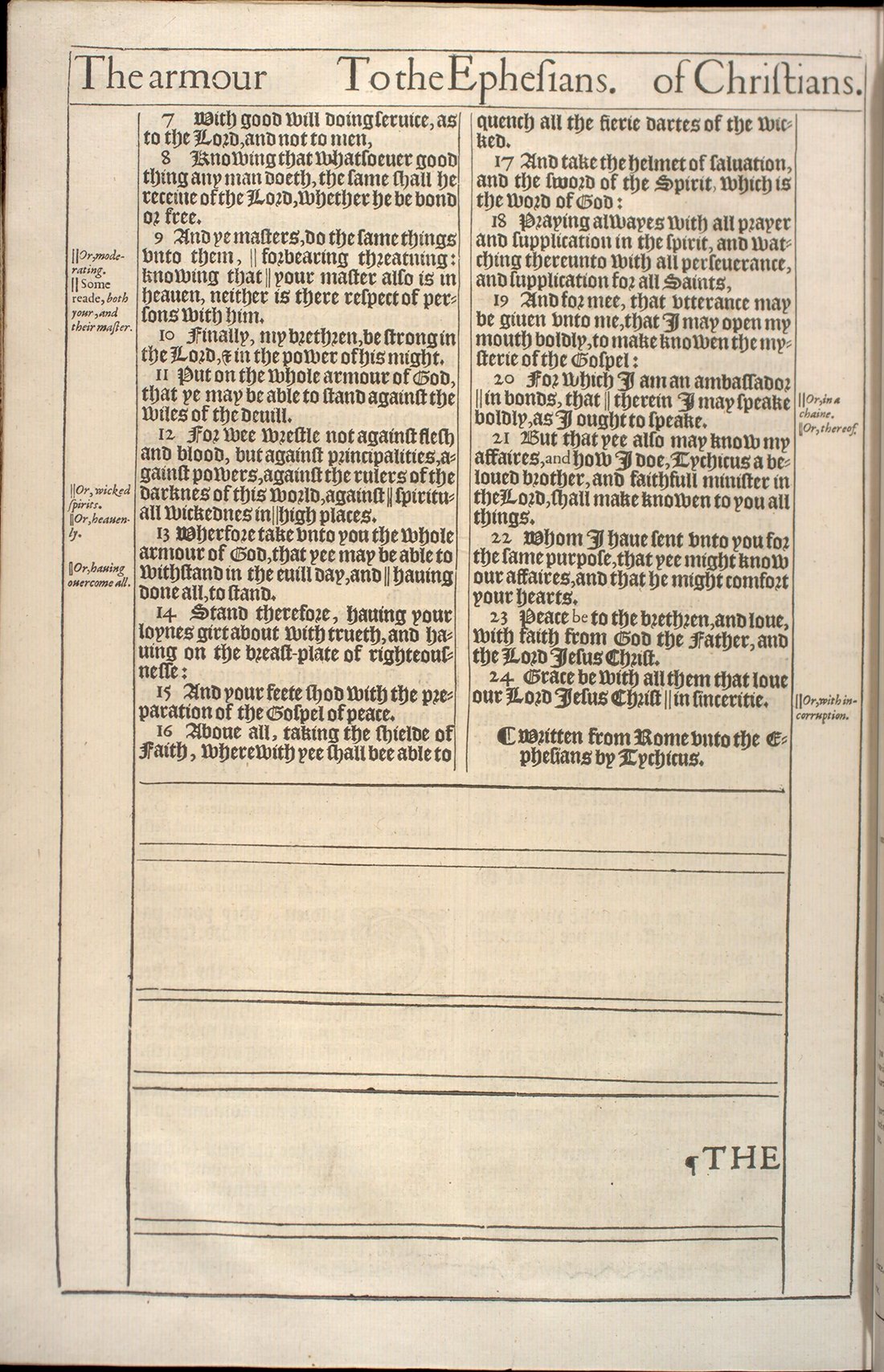
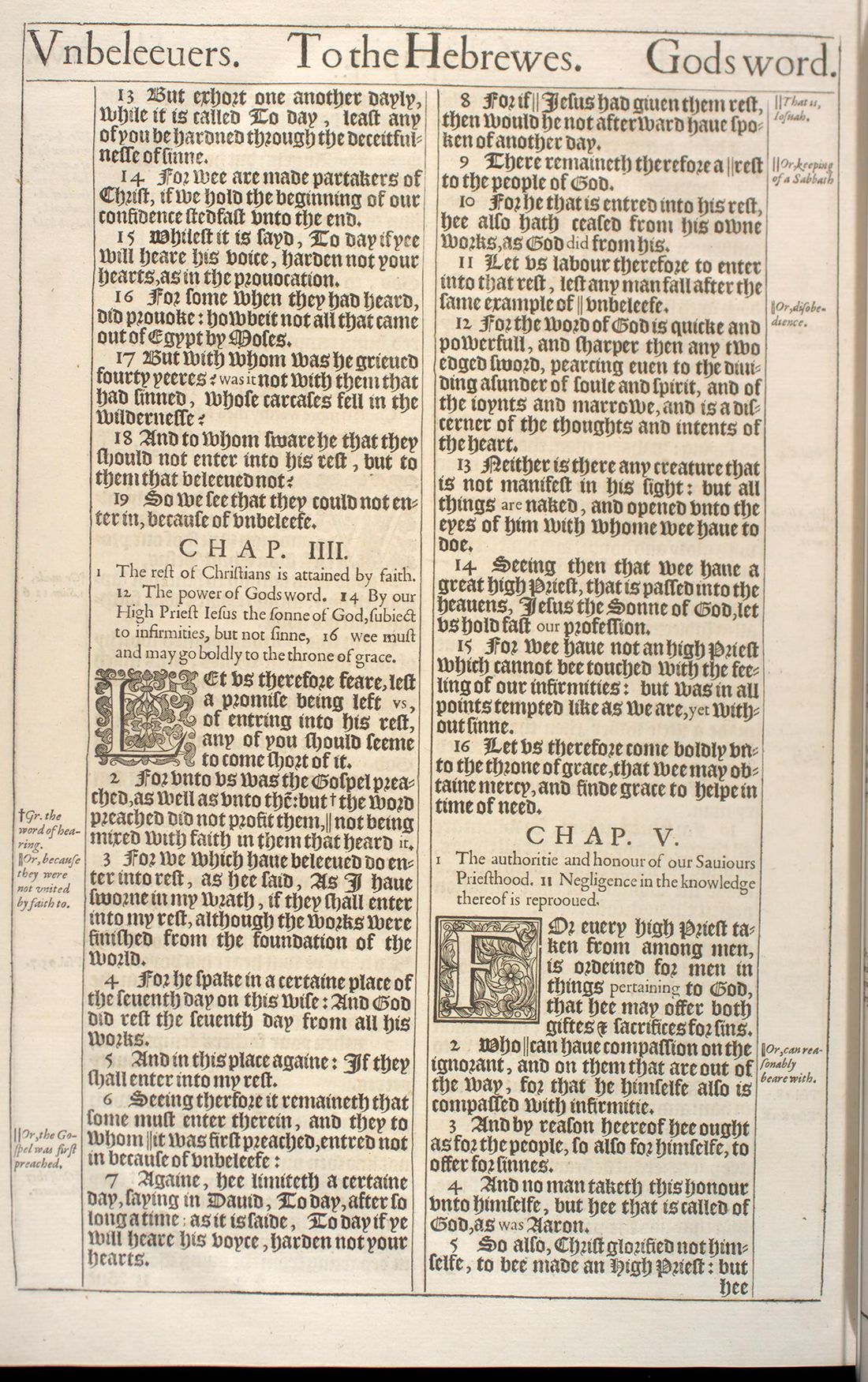
The Holy Bible (London: Robert Barker, 1611), first issue (“He” Bible), Ephesians 6:7–24. University of Pennsylvania Libraries, Kislak Center, Folio BS185 1611 .L65 (Ross Bible Collection); cropped to the leaf · No Copyright – United States (NoC-US)

Plate II.20

The King James Bible of 1611: “The armour of Christians”

Date
1611 (London: Robert Barker)
Held at
University of Pennsylvania, Kislak Center (Folio BS185 1611 .L65)

Ephesians 6:7–24 in the first printing of the King James Bible. The running head reads “The armour / To the Ephesians. / of Christians.” Verse 11: “Put on the whole armour of God, that ye may be able to stand against the wiles of the deuill.” In the margin beside verses 12 and 13 stand the other renderings “Or, wicked spirits.”, “Or, heauenly.” and “Or, hauing ouercome all.”

This is the editio princeps of the Authorised Version, printed in London in 1611 by Robert Barker, the King’s Printer. It is the first issue, called the “Great He Bible” from its reading at Ruth 3:15, “and he went into the citie.” (The Genesis page beside it tells how the translation was made.) The University of Pennsylvania describes the book as a folio printed in black letter, in two columns within rules, with verse divisions, marginal notes and ornamental capitals, each chapter preceded by a summary in roman type. On the page before this one, the summary of Ephesians 6 reads: “10 Our life is a warfare, 12 Not onely against flesh and blood, but also spiritual enemies. 13 The complete armor of a Christian, 18 and how it ought to be vsed.” On this leaf the armour follows piece by piece: loins “girt about with trueth”, “the breast-plate of righteousnesse”, feet “shod with the preparation of the Gospel of peace”, “the shielde of Faith”, “the helmet of saluation, and the sword of the Spirit, which is the word of God”. The small marks “||” in the text send the reader to the margin, where another rendering of the word is printed. The epistle closes at the foot of the second column: “Written from Rome vnto the Ephesians by Tychicus.” On the morning of 19 April 1891 the Baptist C. H. Spurgeon had this chapter read at the Metropolitan Tabernacle before he preached on verse 17 (sermon No. 2201, “The Sword of the Spirit”). Of the believer who “puts on piece by piece of the panoply provided for him”, as this leaf sets it out, he said that “he may wisely say to himself, ‘This warns me of danger; this prepares me for warfare; this prophesies opposition.’” He noted that “the apostle, two or three times, bids us” stand, and that “there is only one weapon of offense provided, although there are several pieces of armor.” That weapon is Scripture: “The Holy Spirit wields no sword but the Word of God.” Of the Lord’s temptation he said: “Our divine Lord in the wilderness was tempted of the devil. He might have fought Satan with a thousand weapons; but he chose to defeat him with this one only.” (His words from the same sermon on why that weapon is “not carnal” hang in the Armoury beside the sword.) This copy came to Penn in 1946 in the Ross Bible Collection, the gift of T. Edward Ross, and still bears his bookplate.

“Put on the whole armour of God, that ye may be able to stand against the wiles of the devil.”

Source find.library.upenn.edu — Penn Libraries catalogue record and Digital Collections item for Folio BS185 1611 .L65 (editio princeps, “Great HE edition”, Ruth 3:15; format, black letter, summaries; Ross bookplate; rights NoC-US). Penn Libraries, “Ross Bible Collection” (gift of T. Edward Ross, 1946). The 1611 words were read from the plate (pp. 1433–34) and checked against King James Bible Online’s 1611 text. Spurgeon, sermon No. 2201 (19 April 1891): Bible Hub × Blue Letter Bible.

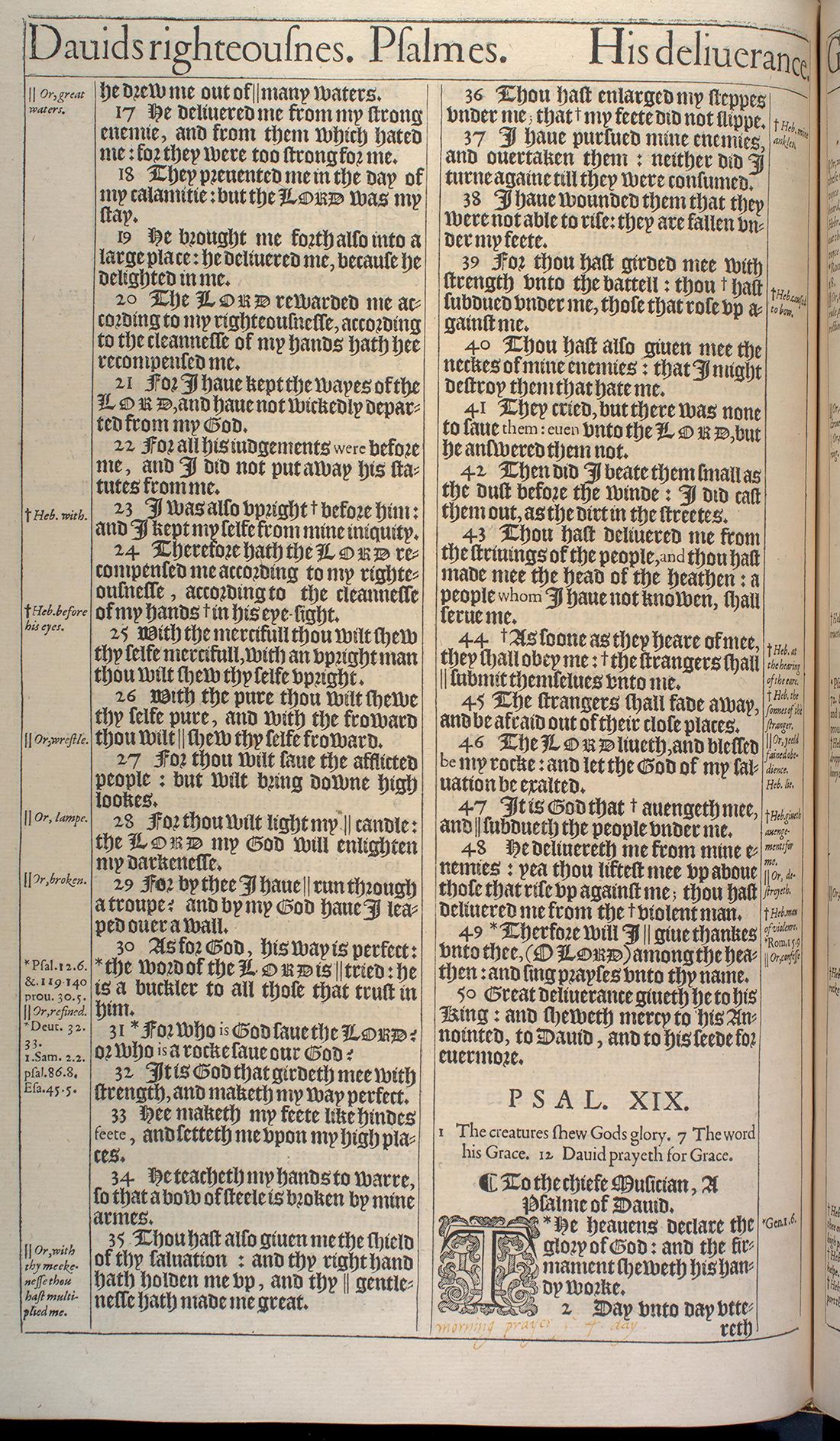
The Holy Bible (London: Robert Barker, 1611), first issue (“He” Bible), Psalm 18:16–19:2. University of Pennsylvania Libraries, Kislak Center, Folio BS185 1611 .L65 (Ross Bible Collection); cropped to the leaf · No Copyright – United States (NoC-US)

Plate II.21

The King James Bible of 1611: “he is a buckler to all those that trust in him”

Date
1611 (London: Robert Barker)
Held at
University of Pennsylvania, Kislak Center (Folio BS185 1611 .L65)

The Book of Psalmes, Psalm 18 from verse 16 to its close, with the opening of Psalm 19, in the first printing of the King James Bible. Verse 30 of Psalm 18: “As for God, his way is perfect: the word of the LORD is tried: he is a buckler to all those that trust in him.” The running head reads “Dauids righteousnes. Psalmes. His deliuerance.”.

The Armoury gives this verse as a cross-reference for the shield of faith, “wherewith ye shall be able to quench all the fiery darts of the wicked” (Ephesians 6:16). Here it is in the 1611 spelling: “As for God, his way is perfect: the word of the LORD is tried: he is a buckler to all those that trust in him.” The printer marks the verse with a star and sets four references in the margin beside it: “Psal.12.6. &.119.140 prou. 30.5.”, and, for the word “tried”, the alternative “Or, refined.”. Verse 31 carries its own references, “Deut. 32. 33. 1.Sam. 2.2. psal.86.8, Esa.45.5.”. Five verses lower on the same leaf stands the other shield of the psalm: “Thou hast also giuen mee the shield of thy saluation: and thy right hand hath holden me vp, and thy gentlenesse hath made me great.” (verse 35), with the margin reading “Or, with thy meekenesse thou hast multiplied me.” for “gentlenesse”. The armour Paul names is not new in Ephesians: the shield here is God himself, and the word of the LORD is the proof of it. A later hand has pencilled a note at the foot of the leaf; it is not transcribed here.

“As for God, his way is perfect: the word of the LORD is tried: he is a buckler to all those that trust in him.”

Source find.library.upenn.edu — Penn Libraries catalogue record and Digital Collections item for Folio BS185 1611 .L65 (NoC-US, as for the other 1611 leaves; IIIF manifest re-fetched 2026-10-05). The 1611 words and margin notes were read from the plate (p. 654) at full resolution. Modern KJV Psalm 18:30 and 18:35 checked on bible-api.com and api.getbible.net.

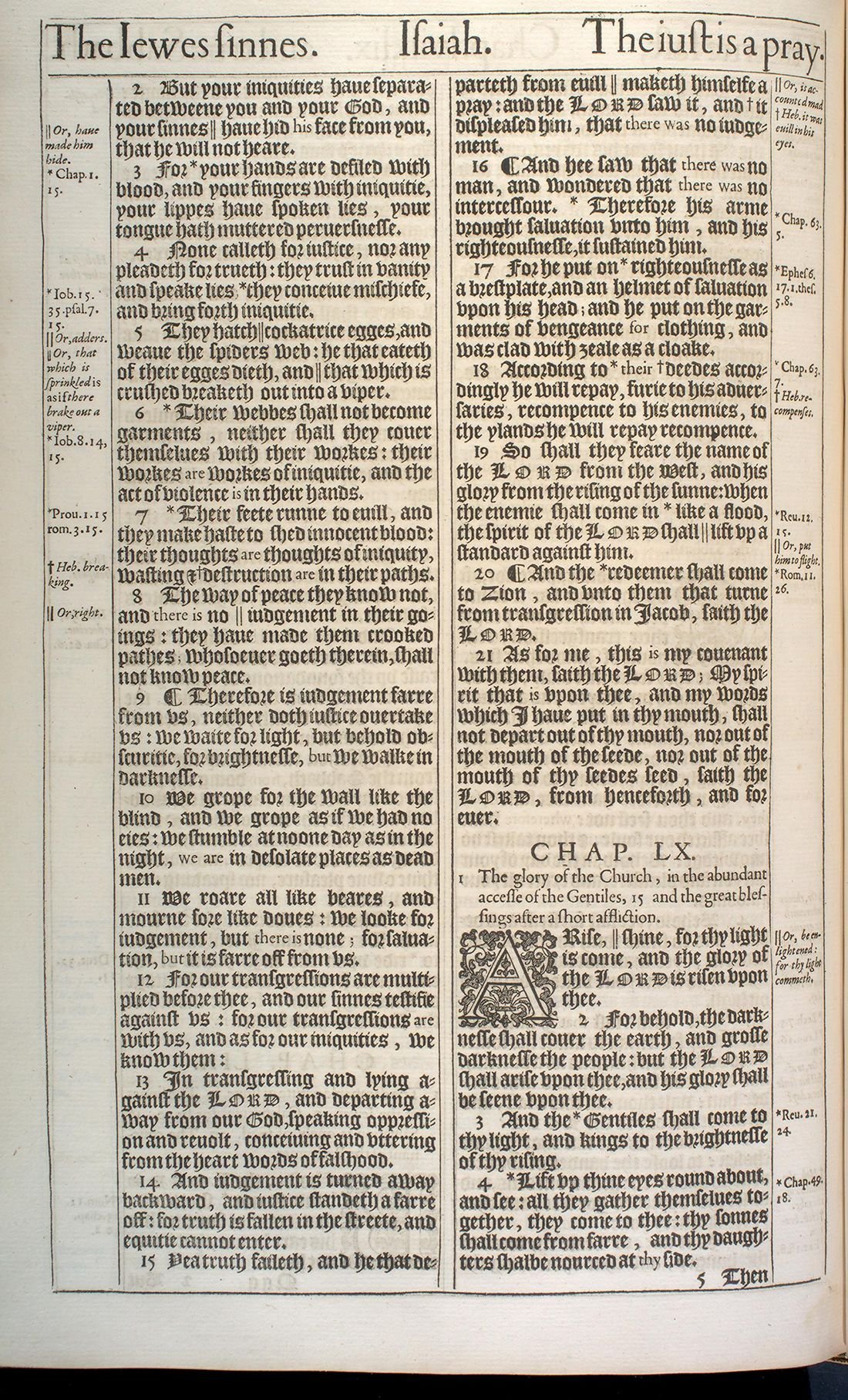
The Holy Bible (London: Robert Barker, 1611), first issue (“He” Bible), Isaiah 59:2–60:4. University of Pennsylvania Libraries, Kislak Center, Folio BS185 1611 .L65 (Ross Bible Collection); cropped to the leaf · No Copyright – United States (NoC-US)

Plate II.22

The King James Bible of 1611: “righteousnesse as a brestplate”

Date
1611 (London: Robert Barker)
Held at
University of Pennsylvania, Kislak Center (Folio BS185 1611 .L65)

Isaiah 59:2–21 in the first printing of the King James Bible. Verse 17: “For he put on righteousnesse as a brestplate, and an helmet of saluation vpon his head; and he put on the garments of vengeance for clothing, and was clad with zeale as a cloake.” In the margin beside it, the translators send the reader to Ephesians 6:17 and 1 Thessalonians 5:8.

The armour Paul names did not begin with Paul. In Isaiah 59 it is the LORD himself who puts it on. The chapter summary, printed on the page before this one, reads: “1 The damnable nature of sinne. 3 The sinnes of the Iewes. 9 Calamitie is for sinne. 16 Saluation is onely of God. 20 The couenant of the Redeemer.” On this leaf the prophet finds that “truth is fallen in the streete”, and that there is “no man” and “no intercessour”. Then: “Therefore his arme brought saluation vnto him, and his righteousnesse, it sustained him. For he put on righteousnesse as a brestplate, and an helmet of saluation vpon his head.” The asterisk before “righteousnesse” in verse 17 sends the reader to the margin, where the translators of 1611 point to Ephesians 6:17 (“And take the helmet of saluation”) and 1 Thessalonians 5:8 (in today’s KJV spelling, “putting on the breastplate of faith and love; and for an helmet, the hope of salvation”). The breastplate and helmet that the saints are bidden to take up are the LORD’s own armour; the salvation is his. The chapter closes with “the redeemer” who “shall come to Zion”. The Baptist C. H. Spurgeon, in an exposition of these verses (read with Psalm 103 and Isaiah 60), said of verse 16: “Man’s extremity was Christ’s opportunity. There was no one left to save poor fallen manhood, no one who could lift a hand or a finger for our rescue; therefore, Jesus came, and fought, and bled, and died, and conquered on our behalf.” On the verses that follow he added, “Christ came once, and he is to come a second time”, and on verse 21, where the LORD promises that his words “shall not depart out of thy mouth”: “The Church of God shall have the Spirit of truth and the Word of truth ever abiding in her midst.” This is the same copy as the Ephesians leaf beside it: the editio princeps of 1611, the “Great He Bible”, given to Penn in 1946 in the Ross Bible Collection.

“For he put on righteousness as a breastplate, and an helmet of salvation upon his head; and he put on the garments of vengeance for clothing, and was clad with zeal as a cloke.”

Source find.library.upenn.edu — Penn Libraries catalogue record and Digital Collections item for Folio BS185 1611 .L65 (editio princeps, “Great HE edition”; rights NoC-US), as for the Ephesians leaf. The 1611 words were read from the plate (pp. 809–810) and checked against King James Bible Online’s 1611 text of Isaiah 59. The 1611 words of Ephesians 6:17 are from the Ephesians leaf (p. 1434). Spurgeon, exposition of Isaiah 59:16–21 (read with Psalm 103 and Isaiah 60:1–16): SermonIndex × BibliaPlus.

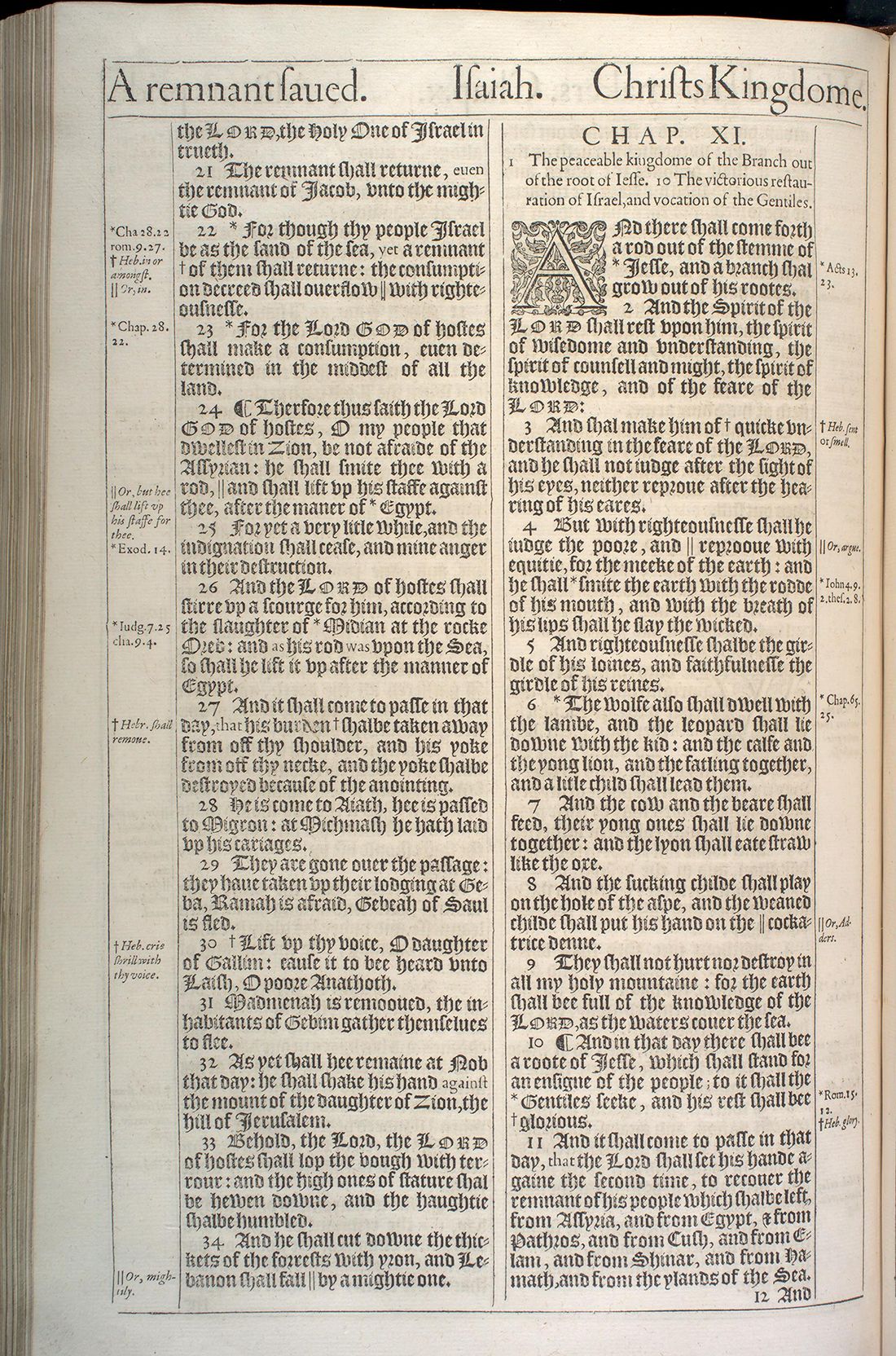
The Holy Bible (London: Robert Barker, 1611), first issue (“He” Bible), Isaiah 10:20–11:11. University of Pennsylvania Libraries, Kislak Center, Folio BS185 1611 .L65 (Ross Bible Collection); cropped to the leaf · No Copyright – United States (NoC-US)

Plate II.23

The King James Bible of 1611: “the girdle of his loines”

Date
1611 (London: Robert Barker)
Held at
University of Pennsylvania, Kislak Center (Folio BS185 1611 .L65)

Isaiah 10:20–11:11 in the first printing of the King James Bible. Verse 5 of chapter XI: “And righteousnesse shalbe the girdle of his loines, and faithfulnesse the girdle of his reines.” The running head over the chapter reads “Christs Kingdome.”

Paul bids the saints stand “having your loins girt about with truth” (Ephesians 6:14). This museum’s Armoury sets Isaiah 11:5 beside that girdle, and here is the verse as the first readers of the King James Bible met it. The translators’ summary at the head of chapter XI reads: “1 The peaceable kingdome of the Branch out of the root of Iesse. 10 The victorious restauration of Israel, and vocation of the Gentiles.” The chapter opens: “And there shall come forth a rod out of the stemme of Iesse, and a branch shal grow out of his rootes. And the Spirit of the LORD shall rest vpon him.” Of the girdle in verse 5, the Baptist John Gill wrote in his Exposition: “He shall be adorned with it, strengthened by it, and ready at all times to perform it”. He adds that the verse “is said of a single person, of the Messiah only, to whom it properly belongs.” The girdle is first Christ’s own; the truth that girds the saint is his. No margin note stands beside verse 5 on this page. This is the same copy as the Ephesians and Isaiah 59 leaves beside it: the editio princeps of 1611, the “Great He Bible”, given to Penn in 1946 in the Ross Bible Collection.

“And righteousness shall be the girdle of his loins, and faithfulness the girdle of his reins.”

Source find.library.upenn.edu — Penn Libraries catalogue record and Digital Collections item for Folio BS185 1611 .L65 (NoC-US), as for the Ephesians leaf. The 1611 words were read from the plate (p. 770) and checked against King James Bible Online’s 1611 Isaiah 11:5. Gill: Exposition on Isaiah 11:5, Bible Hub (biblehub.com/commentaries/gill/isaiah/11.htm), checked against Bible Study Tools.

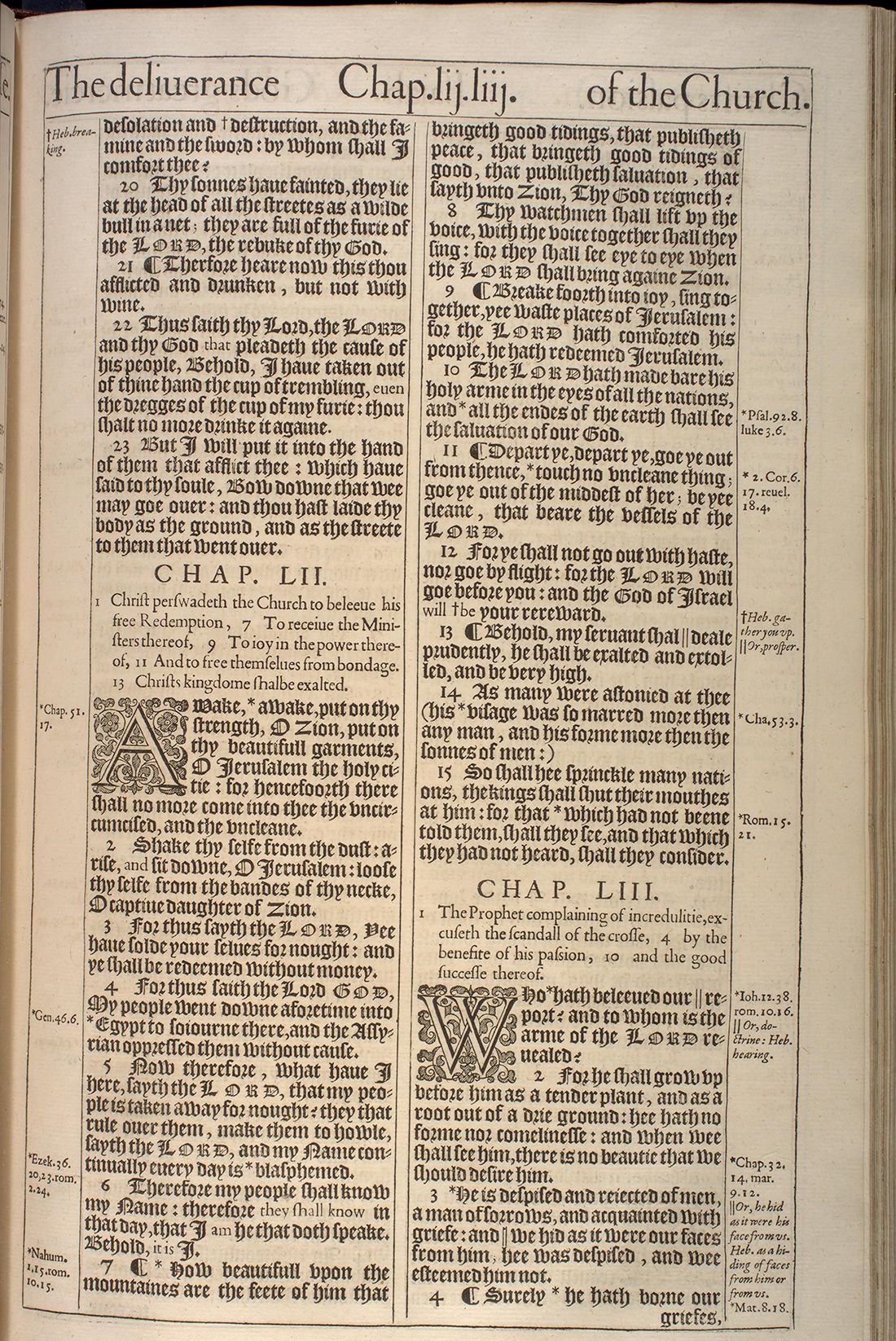
The Holy Bible (London: Robert Barker, 1611), first issue (“He” Bible), Isaiah 51:19–53:4. University of Pennsylvania Libraries, Kislak Center, Folio BS185 1611 .L65 (Ross Bible Collection); cropped to the leaf · No Copyright – United States (NoC-US)

Plate II.24

The King James Bible of 1611: “How beautifull vpon the mountaines”

Date
1611 (London: Robert Barker)
Held at
University of Pennsylvania, Kislak Center (Folio BS185 1611 .L65)

Isaiah 51:19–53:4 in the first printing of the King James Bible. Verse 7 of chapter LII: “How beautifull vpon the mountaines are the feete of him that bringeth good tidings, that publisheth peace, that bringeth good tidings of good, that publisheth saluation, that sayth vnto Zion, Thy God reigneth?”

Paul bids the saints have their “feet shod with the preparation of the gospel of peace” (Ephesians 6:15). This museum’s Armoury sets Isaiah 52:7 beside those shoes. On this leaf the translators summarise chapter LII: “1 Christ perswadeth the Church to beleeue his free Redemption, 7 To receiue the Ministers thereof, 9 To ioy in the power thereof, 11 And to free themselues from bondage. 13 Christs kingdome shalbe exalted.” The chapter opens “Awake, awake, put on thy strength, O Zion, put on thy beautifull garments”. The asterisk before verse 7 sends the reader to the margin, where the translators point to Nahum 1:15 and Romans 10:15, where Paul applies the verse to “them that preach the gospel of peace”. The Baptist John Gill, in his Exposition, read the verse “best of Christ himself, the messenger of the covenant, who was anointed to preach glad tidings to the meek, and by whom grace, peace, life, and salvation came”. He applied it also to the gospel’s ministers, “and their feet are particularly so, being shod with the preparation of the Gospel of peace.” Below, on the same page, chapter LIII begins: “Who hath beleeued our report?” This is the same copy as the other 1611 leaves in this room, given to Penn in 1946 in the Ross Bible Collection.

“How beautiful upon the mountains are the feet of him that bringeth good tidings, that publisheth peace; that bringeth good tidings of good, that publisheth salvation; that saith unto Zion, Thy God reigneth!”

Source find.library.upenn.edu — Penn Libraries catalogue record and Digital Collections item for Folio BS185 1611 .L65 (NoC-US). The 1611 words were read from the plate (p. 805) and checked against King James Bible Online’s 1611 Isaiah 52. Romans 10:15 KJV checked bible-api × getBible. Gill: Exposition on Isaiah 52:7, Bible Hub (biblehub.com/commentaries/gill/isaiah/52.htm), checked against Bible Study Tools.

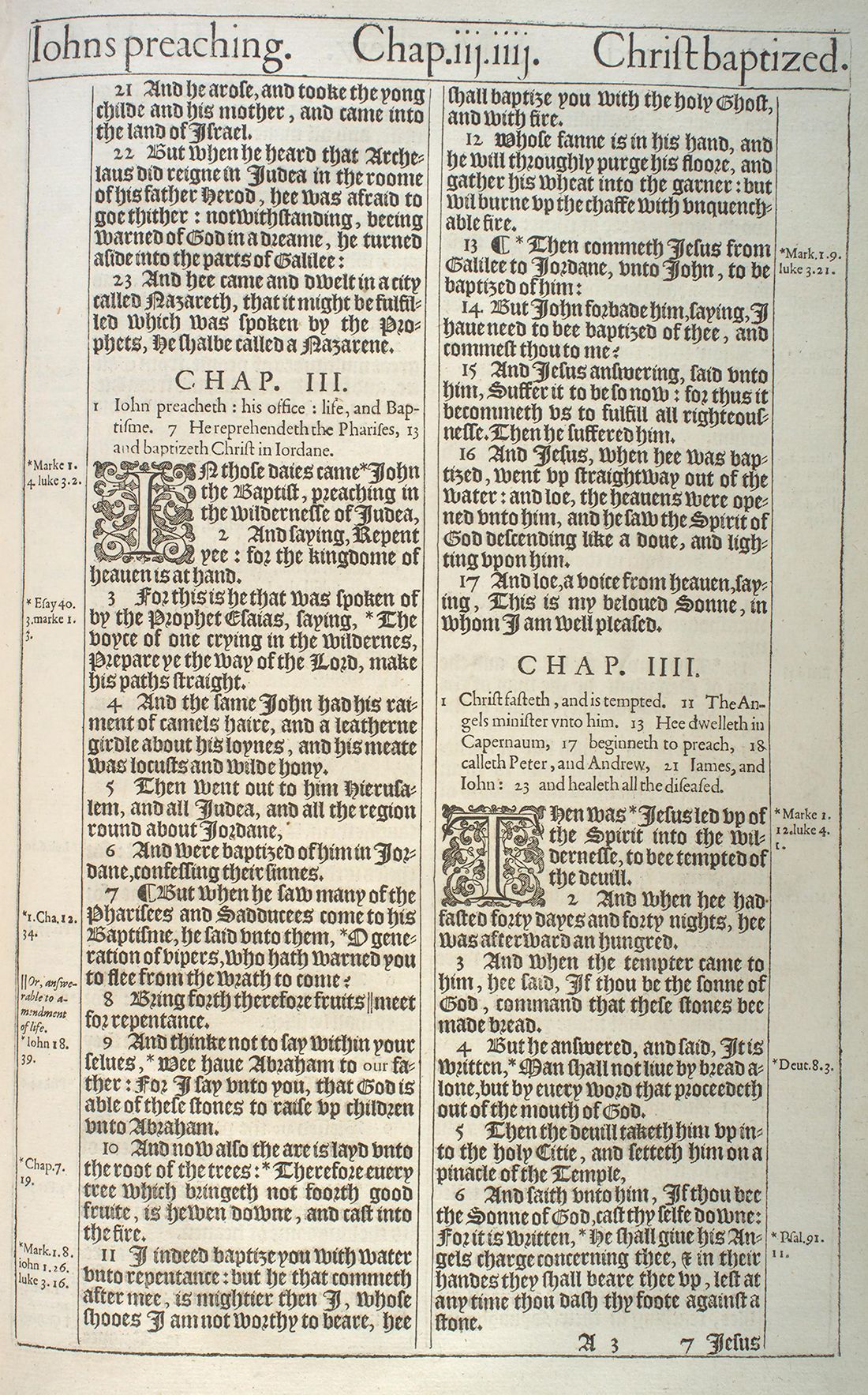
The Holy Bible (London: Robert Barker, 1611), first issue (“He” Bible), Matthew 2:21–4:6. University of Pennsylvania Libraries, Kislak Center, Folio BS185 1611 .L65 (Ross Bible Collection); cropped to the leaf · No Copyright – United States (NoC-US)

Plate II.25

The King James Bible of 1611: “It is written, Man shall not liue by bread alone”

Date
1611 (London: Robert Barker)
Held at
University of Pennsylvania, Kislak Center (Folio BS185 1611 .L65)

The Gospel according to Saint Matthew, from 2:21 through 4:6, in the first printing of the King James Bible. Chapter 4, verse 4: “But he answered, and said, It is written, Man shall not liue by bread alone, but by euery word that proceedeth out of the mouth of God.” The running head reads “Iohns preaching. / Chap.iij.iiij. / Christ baptized.”.

The Armoury names “the sword of the Spirit, which is the word of God” (Ephesians 6:17), and gives this verse as one of its two cross-references for that piece. Led up into the wilderness and hungry after forty days, the Lord Jesus is met by the tempter, who says, “If thou bee the Sonne of God, command that these stones bee made bread.” He does not argue from His own power. He answers from the Book: “It is written, Man shall not liue by bread alone, but by euery word that proceedeth out of the mouth of God.” The printer sets a mark before the quotation and, in the margin, the reference “Deut.8.3.” — the Lord is quoting Moses. When the tempter himself quotes Scripture in the next verses, the margin sends the reader to “Psal.91.11.”, and the Lord answers again with what is written. Higher on the same leaf, in chapter 3, John the Baptist is described as having “a leatherne girdle about his loynes”. The sword the Christian soldier takes up is not his own wit; it is the word of God, and the Lord shows how it is used: “It is written.”

“But he answered and said, It is written, Man shall not live by bread alone, but by every word that proceedeth out of the mouth of God.”

Source find.library.upenn.edu — Penn Libraries catalogue record and Digital Collections item for Folio BS185 1611 .L65 (NoC-US, as for the other 1611 leaves; IIIF manifest re-fetched 2026-10-05). The 1611 words and the margin notes were read from the plate (p. 1221) at full resolution. Modern KJV Matthew 4:3–6 checked on bible-api.com and api.getbible.net (identical).

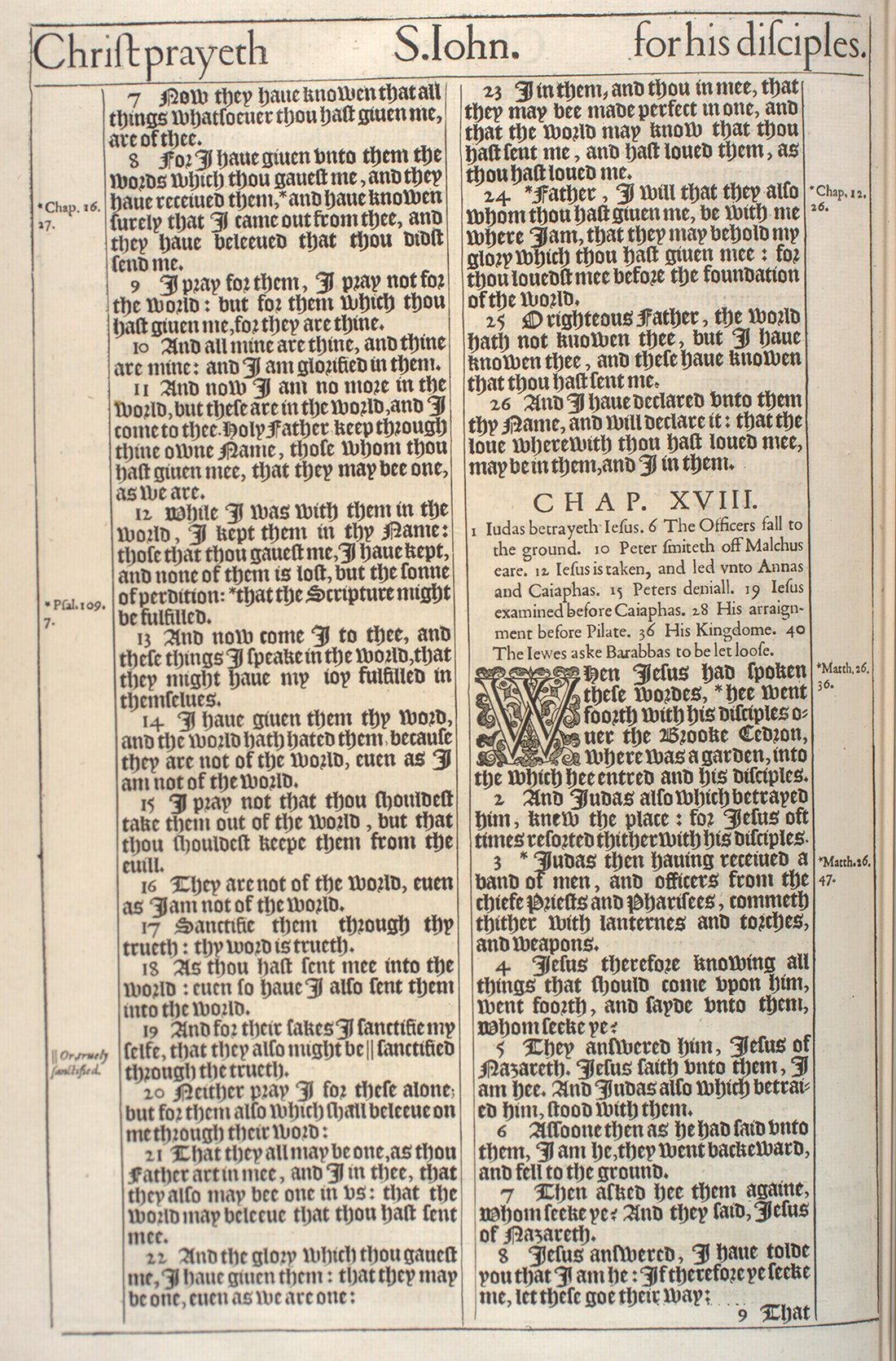
The Holy Bible (London: Robert Barker, 1611), first issue (“He” Bible), John 17:7–18:8. University of Pennsylvania Libraries, Kislak Center, Folio BS185 1611 .L65 (Ross Bible Collection); cropped to the leaf · No Copyright – United States (NoC-US)

Plate II.26

The King James Bible of 1611: “Sanctifie them through thy trueth: thy word is trueth”

Date
1611 (London: Robert Barker)
Held at
University of Pennsylvania, Kislak Center (Folio BS185 1611 .L65)

The Gospel according to Saint John, from 17:7 through the close of the Lord’s prayer for His disciples and into chapter 18, in the first printing of the King James Bible. Verse 17 of chapter 17: “Sanctifie them through thy trueth: thy word is trueth.” The running head reads “Christ prayeth / S.Iohn. / for his disciples.”.

The Armoury shows the loins “girt about with truth” (Ephesians 6:14), and gives this verse as one of its two cross-references for that piece. It is the Lord Jesus Himself, praying to the Father on the night He was betrayed, who says what the truth is: “Sanctifie them through thy trueth: thy word is trueth.” Two verses earlier He asks not that His disciples be taken out of the world: “I pray not that thou shouldest take them out of the world, but that thou shouldest keepe them from the euill.” Two verses later He gives Himself for them: “And for their sakes I sanctifie my selfe, that they also might be sanctified through the trueth.” Beside that verse the printer sets a mark and a marginal reading, “Or, truely sanctified.” Higher on the same column the Lord says of the words the Father gave Him: “For I haue giuen vnto them the words which thou gauest me, and they haue receiued them.” The page runs on into chapter 18, where He goes over the brook Cedron into the garden and is taken. The truth the Christian soldier is girded with is not a feeling or an opinion; it is the word of God.

“Sanctify them through thy truth: thy word is truth.”

Source find.library.upenn.edu — Penn Libraries catalogue record and Digital Collections item for Folio BS185 1611 .L65 (NoC-US, as for the other 1611 leaves; IIIF manifest re-fetched 2026-10-05). The 1611 words and the margin note were read from the plate (p. 1340) at full resolution. Modern KJV John 17:15–19 checked on bible-api.com and api.getbible.net (identical).

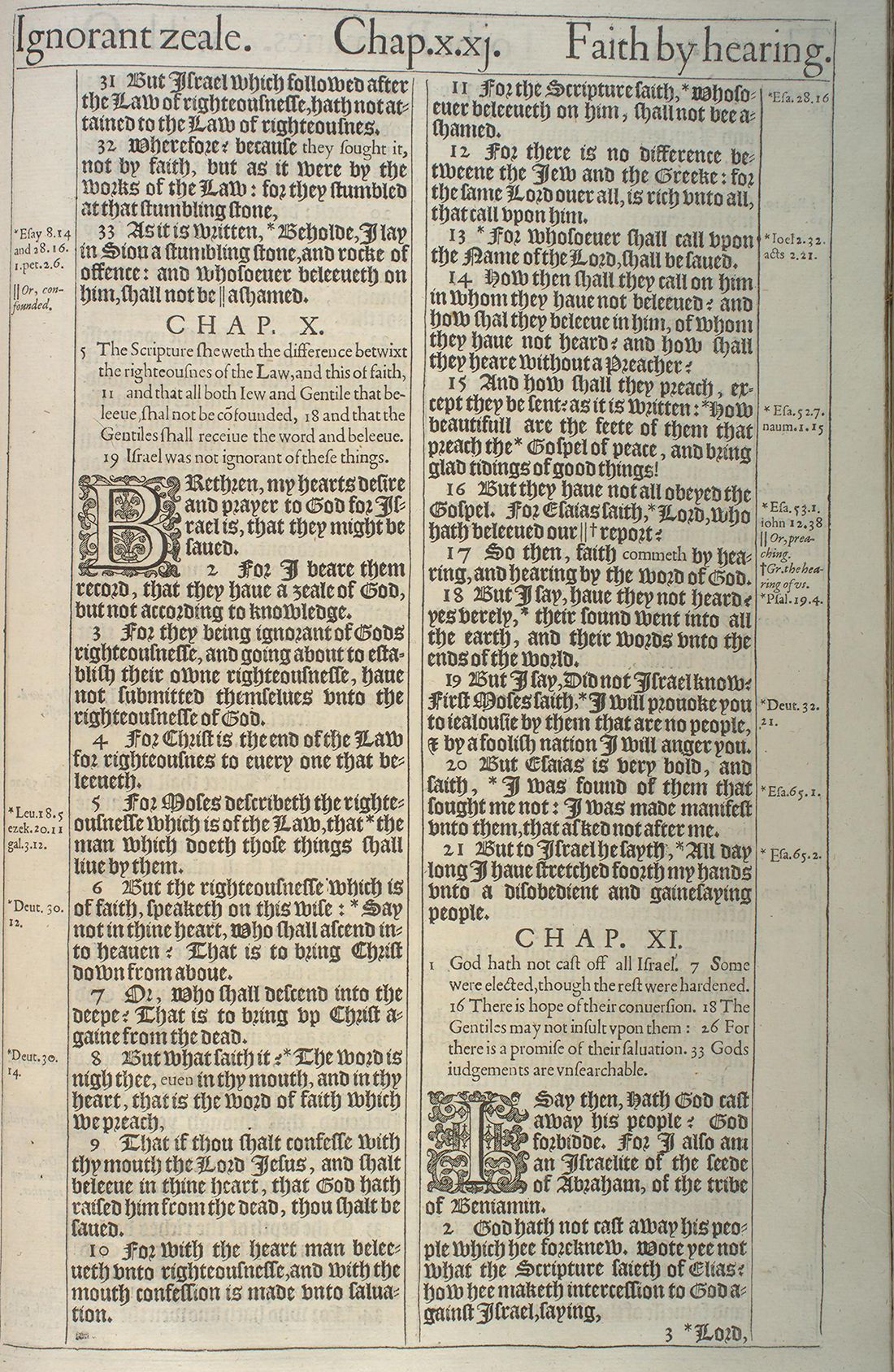
The Holy Bible (London: Robert Barker, 1611), first issue (“He” Bible), Romans 9:31–11:2. University of Pennsylvania Libraries, Kislak Center, Folio BS185 1611 .L65 (Ross Bible Collection); cropped to the leaf · No Copyright – United States (NoC-US)

Plate II.27

The King James Bible of 1611: “How beautifull are the feete of them that preach the Gospel of peace”

Date
1611 (London: Robert Barker)
Held at
University of Pennsylvania, Kislak Center (Folio BS185 1611 .L65)

The Epistle of Paul to the Romans, from 9:31 through the whole of chapter 10 and into chapter 11, in the first printing of the King James Bible. Verse 15 of chapter 10: “And how shall they preach, except they be sent? as it is written: How beautifull are the feete of them that preach the Gospel of peace, and bring glad tidings of good things!”. The running head reads “Ignorant zeale. / Chap.x.xj. / Faith by hearing.”.

The Armoury shows the feet “shod with the preparation of the gospel of peace” (Ephesians 6:15), and gives this verse as one of its two cross-references for that piece. Here it is in the 1611 spelling: “And how shall they preach, except they be sent? as it is written: How beautifull are the feete of them that preach the Gospel of peace, and bring glad tidings of good things!” Paul’s “as it is written” points back to the prophet, and the printer says so in the margin beside the verse: “Esa. 52.7. naum. 1.15.” The Isaiah 52 leaf of this same Bible hangs beside this one in the Gallery. The chapter summary at the head of chapter 10 reads: “5 The Scripture sheweth the difference betwixt the righteousnes of the Law, and this of faith, 11 and that all both Iew and Gentile that beleeue, shal not be cōfounded, 18 and that the Gentiles shall receiue the word and beleeue. 19 Israel was not ignorant of these things.” Beside verse 16 the margin gives “Esa. 53.1. iohn 12.38” for the prophet’s question, and two readings for the word “report”: “Or, preaching.” and “Gr. the hearing of vs.”. The next verse, in the modern King James text, draws the line from the preacher to the hearer: “So then faith cometh by hearing, and hearing by the word of God” (Romans 10:17). The armour Paul names is put on to stand, and the feet are shod to carry the gospel.

“And how shall they preach, except they be sent? as it is written, How beautiful are the feet of them that preach the gospel of peace, and bring glad tidings of good things!”

Source find.library.upenn.edu — Penn Libraries catalogue record and Digital Collections item for Folio BS185 1611 .L65 (NoC-US, as for the other 1611 leaves; IIIF manifest re-fetched 2026-10-05). The 1611 words and margin notes were read from the plate (p. 1393) at full resolution. Modern KJV Romans 10:15 checked on bible-api.com against the Armoury’s verified text.

The Holy Bible (London: Robert Barker, 1611), first issue (“He” Bible), Romans 13:6–14:21. University of Pennsylvania Libraries, Kislak Center, Folio BS185 1611 .L65 (Ross Bible Collection); cropped to the leaf · No Copyright – United States (NoC-US)

Plate II.28

The King James Bible of 1611: “let vs put on the armour of light”

Date
1611 (London: Robert Barker)
Held at
University of Pennsylvania, Kislak Center (Folio BS185 1611 .L65)

Romans 13:6–14 and 14:1–21 in the first printing of the King James Bible. Verse 12: “The night is farre spent, the day is at hand: let vs therefore cast off the workes of darkenesse, and let vs put on the armour of light.” The running head reads “Of loue. / To the Romanes. / Gods iudgment.”

In Ephesians 6 Paul bids the believer “Put on the whole armour of God”. Here, in Romans 13, he uses the same words of putting on, and calls it “the armour of light”. The leaf shows how he gets there. Verse 11 says “now it is high time to awake out of sleepe: for now is our saluation neerer then when we beleeued.” Verse 12 sets night against day: cast off “the workes of darkenesse” and put on “the armour of light.” Verse 13 says how such armour is worn: “Let vs walke honestly as in the day, not in rioting and drunkennesse, not in chambring and wantonnes, not in strife and enuying.” Beside “honestly”, keyed by a double bar, the translators set another rendering in the margin: “Or, decently.” Verse 14 then names what is put on: “But put yee on the Lord Iesus Christ, and make not prouision for the flesh, to fulfill the lusts thereof.” The Baptist expositor John Gill reads “the armour of light” as “the whole armour of God, the use of which lies in the exercise of grace, and discharge of duty”. Below, Chapter XIIII opens with a large decorated initial. This is the same copy as the other 1611 leaves in this room, given to Penn in 1946 in the Ross Bible Collection.

“The night is far spent, the day is at hand: let us therefore cast off the works of darkness, and let us put on the armour of light.”

Source find.library.upenn.edu — Penn Libraries record for Folio BS185 1611 .L65 (NoC-US), as for the Ephesians leaf. 1611 words and margin read from the plate (p. 1396), checked against King James Bible Online’s 1611 Romans 13. Modern KJV: bible-api.com × api.getbible.net. Gill, Exposition (1746–63), on 13:12: Bible Hub × Bible Study Tools.

The Holy Bible (London: Robert Barker, 1611), first issue (“He” Bible), 2 Corinthians 6:1–7:9. University of Pennsylvania Libraries, Kislak Center, Folio BS185 1611 .L65 (Ross Bible Collection); cropped to the leaf · No Copyright – United States (NoC-US)

Plate II.29

The King James Bible of 1611: “the armour of righteousnesse, on the right hand, and on the left”

Date
1611 (London: Robert Barker)
Held at
University of Pennsylvania, Kislak Center (Folio BS185 1611 .L65)

The Second Epistle of Paul to the Corinthians, from the end of the chapter summary through chapter 6 and into chapter 7, in the first printing of the King James Bible. Verse 7 of chapter 6: “By the Worde of trueth, by the power of God, by the armour of righteousnesse, on the right hand, and on the left,”. The running head reads “True Ministers. / II.Corinthians. / Of godly, and”.

In the list of what marks a true minister of Christ, Paul names “the armour of righteousness on the right hand and on the left” (2 Corinthians 6:7); the Armoury shows the same gift as the breastplate of Ephesians 6:14. The sentence is set in the 1611 spelling: “By the Worde of trueth, by the power of God, by the armour of righteousnesse, on the right hand, and on the left,”. Armour for the right hand and the left is armour for both sides at once, for a servant of Christ who meets “honour and dishonour”, “euill report and good report” (6:8) alike. The word is truth, the power is God’s, and the armour is righteousness; nothing here is carried in the hand of flesh. The leaf opens on the tail of the chapter summary, “heart is open to them, 13 And he expecteth the like affection from them againe, 14 Exhorting to flee the societie and pollutions of Idolaters, as being themselues Temples of the liuing God.” Three notes stand in the margin: “Esa. 49.8.” beside verse 2, “Gr. commending.” at “approuing” in verse 4, and “Or, in tossings to and fro.” at “tumults” in verse 5. Verse 2 itself is set in parentheses in the 1611 text: “(For he saith, I haue heard thee in a time accepted, and in the day of saluation haue I succoured thee: beholde, now is the accepted time, behold, now is the day of saluation)”. Chapter 7 begins on the same leaf, with its own summary in roman type.

“By the word of truth, by the power of God, by the armour of righteousness on the right hand and on the left,”

Source find.library.upenn.edu — Penn Libraries catalogue record and Digital Collections item for Folio BS185 1611 .L65 (NoC-US, as for the other 1611 leaves; IIIF manifest re-fetched 2026-10-05). The 1611 words and margin notes were read from the plate (p. 1418) at full resolution. Modern KJV 2 Corinthians 6:7 checked on bible-api.com and api.getbible.net.

The Holy Bible (London: Robert Barker, 1611), first issue (“He” Bible), 2 Corinthians 10:2–11:9. University of Pennsylvania Libraries, Kislak Center, Folio BS185 1611 .L65 (Ross Bible Collection); cropped to the leaf · No Copyright – United States (NoC-US)

Plate II.30

The King James Bible of 1611: “the weapons of our warfare are not carnal”

Date
1611 (London: Robert Barker)
Held at
University of Pennsylvania, Kislak Center (Folio BS185 1611 .L65)

2 Corinthians 10:2–18 and 11:1–9 in the first printing of the King James Bible. Verse 4: “(For the weapons of our warfare are not carnal, but mighty through God to the pulling downe of strong holds.)” The running head reads “Pauls weapons, / Chap.xj. / His godly ielousie.”

This is the verse written over the door of the Armoury in this museum, shown here as the translators of 1611 first printed it. Paul begins: “For though we walke in the flesh, we doe not warre after the flesh:” and then, inside the parentheses, says what kind of weapons these are. They are “not carnal, but mighty through God”. The next verse names the strong holds they pull down: “Casting down imaginations, and euery high thing that exalteth it selfe against the knowledge of God, and bringing into captiuitie euery thought to the obedience of Christ:”. The strong holds are imaginations, proud things and thoughts, and the victory is obedience to Christ. In the margin the translators set two other renderings, each keyed to the text by a double bar: beside “through God” they printed “Or, to God.”, and beside “imaginations”, “Or, reasonings.” Ephesians 6, hung in this room, names the pieces of the armour of God; this leaf says plainly what that armour is not. John Gill wrote in his Exposition that the weapons are “the Scriptures of truth, the sword of the Spirit, the word of God; and which indeed are an armoury, out of which may be taken weapons of all sorts, both offensive and defensive”. They are “not the temporal sword; for Christ sent forth his apostles without that, naked and unarmed amidst their enemies, his kingdom not being of this world”. The strong holds, he wrote, are “the strong holds of sin and Satan; such as unbelief, pride, hardness of heart”. Gill reads this warfare first as the work of the gospel ministry, “peculiar to the ministers of the Gospel”, and among its weapons he names the graces of Ephesians 6: “the breast plate of faith in Christ” and “the helmet of salvation, hope, the girdle of truth and faithfulness”. Lower in the second column, Chapter XI opens with a large decorated initial. This is the same copy as the other 1611 leaves in this room, given to Penn in 1946 in the Ross Bible Collection.

“(For the weapons of our warfare are not carnal, but mighty through God to the pulling down of strong holds;)”

Source find.library.upenn.edu — Penn Libraries catalogue record and Digital Collections item for Folio BS185 1611 .L65 (NoC-US), as for the Ephesians leaf. The 1611 words and the two margin readings were read from the plate (p. 1421) and checked against King James Bible Online’s 1611 2 Corinthians 10. Modern KJV checked on bible-api.com and api.getbible.net. Gill, Exposition (1746–48), on 10:4: Bible Hub × Bible Study Tools.

The Holy Bible (London: Robert Barker, 1611), first issue (“He” Bible), Philippians 4:1–23. University of Pennsylvania Libraries, Kislak Center, Folio BS185 1611 .L65 (Ross Bible Collection); cropped to the leaf · No Copyright – United States (NoC-US)

Plate II.31

The King James Bible of 1611: “Bee carefull for nothing: but in euery thing by prayer”

Date
1611 (London: Robert Barker)
Held at
University of Pennsylvania, Kislak Center (Folio BS185 1611 .L65)

The whole of the fourth chapter of Paul’s Epistle to the Philippians, in the first printing of the King James Bible. Chapter 4, verse 6: “Bee carefull for nothing: but in euery thing by prayer and supplication with thankesgiuing, let your request be made knowen vnto God.” The running head reads “Booke of life. / To the Philippians. / Contentation.”, and the leaf ends with the note “It was written to the Philippians from Rome, by Epaphroditus.”

The Armoury closes the Whole Armour with “Praying always with all prayer and supplication in the Spirit” (Ephesians 6:18), and gives this verse as one of its two cross-references for that last word. Written from Rome, from a prisoner to a church he loved, the chapter opens “so stand fast in the Lord” — the same standing the soldier of Christ is told to keep in Ephesians 6. Then comes the remedy for care: “Bee carefull for nothing: but in euery thing by prayer and supplication with thankesgiuing, let your request be made knowen vnto God.” The promise follows at once: “And the peace of God which passeth all vnderstanding, shall keepe your hearts & minds through Christ Iesus.” Further down the second column the Apostle says, “I can do all things through Christ, which strengtheneth me” (v. 13) — strength “in the Lord”, not in himself, as Ephesians 6:10 has it. Two small differences from the modern King James text can be seen on the leaf: the 1611 printing has “your request” where later editions read “your requests”, and it sets an ampersand-sign between “hearts” and “minds”. The margins carry the translators’ alternative renderings, among them “Or, venerable.” beside “honest” in verse 8 and “Or, I haue receiued all.” at verse 18.

“Be careful for nothing; but in every thing by prayer and supplication with thanksgiving let your requests be made known unto God.”

Source find.library.upenn.edu — Penn Libraries catalogue record and Digital Collections item for Folio BS185 1611 .L65 (NoC-US, as for the other 1611 leaves; IIIF manifest re-fetched 2026-10-05). The 1611 words and the margin notes were read from the plate (p. 1438) at full resolution. Modern KJV Philippians 4:6–7 checked on bible-api.com and api.getbible.net (identical).

The Holy Bible (London: Robert Barker, 1611), first issue (“He” Bible), 1 Thessalonians 4:17–5:28. University of Pennsylvania Libraries, Kislak Center, Folio BS185 1611 .L65 (Ross Bible Collection); cropped to the leaf · No Copyright – United States (NoC-US)

Plate II.32

The King James Bible of 1611: “the brestplate of faith and loue”

Date
1611 (London: Robert Barker)
Held at
University of Pennsylvania, Kislak Center (Folio BS185 1611 .L65)

The whole of 1 Thessalonians 5 in the first printing of the King James Bible. Verse 8: “But let vs who are of the day, bee sober, putting on the brestplate of faith and loue, and for an helmet, the hope of saluation.” The running head reads “Day of the Lord. / Chap.v. / Be at peace.”

In the margin of Isaiah 59, hung in this room, the translators of 1611 sent the reader on to two places: Ephesians 6:17 and 1 Thessalonians 5:8. This is the second of them. The translators’ summary at the head of the chapter reads: “1 Hee proceedeth in the former description of Christs comming to iudgement, 16 and giueth diuers precepts, 23 and so concludeth the Epistle.” Paul tells the church that “the day of the Lord so commeth as a thiefe in the night”, and then: “Yee are all the children of light, and the children of the day: we are not of the night, nor of darkenesse. Therefore let vs not sleepe, as doe others: but let vs watch and be sober.” Here the breastplate is faith and love, and the helmet is hope. The Baptist John Gill wrote in his Exposition that faith “is a considerable part of the Christian soldier’s breastplate”, and that for this reason the breastplate of Ephesians 6:14 is called “the breastplate of righteousness”. Of the helmet he wrote that the “hope of salvation by Christ, is fitly compared” to it, and that “a Christian clothed and armed with these graces, faith, hope, and love, should be so far from indulging himself in sin and sloth, that he ought always to be sober and watchful”. Lower in the same column stands verse 17, “Pray without ceasing”. No margin note stands beside verse 8 on this page. At the foot the printer set the subscription “The first Epistle vnto the Thessalonians, was written from Athens.” This is the same copy as the other 1611 leaves in this room, given to Penn in 1946 in the Ross Bible Collection.

“But let us, who are of the day, be sober, putting on the breastplate of faith and love; and for an helmet, the hope of salvation.”

Source find.library.upenn.edu — Penn Libraries catalogue record and Digital Collections item for Folio BS185 1611 .L65 (NoC-US), as for the Ephesians leaf. The 1611 words were read from the plate (p. 1445) and checked against King James Bible Online’s 1611 1 Thessalonians 5. Gill: Exposition on 1 Thessalonians 5:8, Bible Hub (biblehub.com/commentaries/gill/1_thessalonians/5.htm), checked against Bible Study Tools.

The Holy Bible (London: Robert Barker, 1611), first issue (“He” Bible), 1 Timothy 1. University of Pennsylvania Libraries, Kislak Center, Folio BS185 1611 .L65 (Ross Bible Collection); cropped to the leaf · No Copyright – United States (NoC-US)

Plate II.33

The King James Bible of 1611: “warre a good warfare”

Date
1611 (London: Robert Barker)
Held at
University of Pennsylvania, Kislak Center (Folio BS185 1611 .L65)

The First Epistle of Paul the Apostle to Timothie, chapter 1, in the first printing of the King James Bible. Verse 18: “This charge I commit vnto thee, sonne Timothie, according to the prophesies which went before on thee, that thou by them mightest warre a good warfare”. The running head reads “End of the Law. / I.Timothie. / Why Christ came.”

This is the opening leaf of the letter whose last chapter hangs beside it, and its charge is the soldier’s first. Paul gives Timothy what he calls “this charge” and tells him what it is for: “that thou by them mightest warre a good warfare, Holding faith, and a good conscience, which some hauing put away, concerning faith, haue made shipwracke.” The warfare is named by what he is to hold: faith and a good conscience, not any weapon of steel. In 1611 the verb is spelled “warre” and the noun “warfare”; modern editions print “war a good warfare”. The chapter summary, set in roman type, reads “Timothie is put in mind of the charge which was giuen vnto him by Paul at his going to Macedonia. 5 Of the right vse and end of the Law. 11 Of Saint Pauls calling to be an Apostle, 20 and of Hymeneus & Alexander.” Earlier on the leaf, in verse 15, stands a line the translators set in plain words: “This is a faithfull saying, and worthy of all acceptation, that Christ Iesus came into the world to saue sinners, of whom I am chiefe.” In the margin at verse 6 they print “Or, not aiming at.” beside “hauing swarued”. Read with the other three 1611 leaves in this room, 1 Timothy 6 (“Fight the good fight of faith”), 2 Timothy 2 (“indure hardnesse, as a good souldier of Iesus Christ”) and 2 Timothy 4 (“I haue fought a good fight”), this leaf gives the beginning of the charge: the good warfare is waged by holding faith and a clean conscience. This is the same copy as the other 1611 leaves in this room, given to Penn in the Ross Bible Collection.

“This charge I commit unto thee, son Timothy, according to the prophecies which went before on thee, that thou by them mightest war a good warfare; Holding faith, and a good conscience; which some having put away concerning faith have made shipwreck:”

Source find.library.upenn.edu — Penn Libraries catalogue record and Digital Collections item for Folio BS185 1611 .L65 (NoC-US, as for the other 1611 leaves; IIIF manifest re-fetched 2026-10-05). The 1611 words and the margin reading were read from the plate (p. 1448) at full resolution. Modern KJV 1 Timothy 1:18–19 checked on bible-api.com and api.getbible.net.

The Holy Bible (London: Robert Barker, 1611), first issue (“He” Bible), 1 Timothy 5:16–6:19. University of Pennsylvania Libraries, Kislak Center, Folio BS185 1611 .L65 (Ross Bible Collection); cropped to the leaf · No Copyright – United States (NoC-US)

Plate II.34

The King James Bible of 1611: “Fight the good fight of faith”

Date
1611 (London: Robert Barker)
Held at
University of Pennsylvania, Kislak Center (Folio BS185 1611 .L65)

1 Timothy 5:16–6:19 in the first printing of the King James Bible. Chapter 6, verse 12: “Fight the good fight of faith, lay hold on eternall life.” The running head reads “Of Elders. / Chap.vj. / Godlinesse, gaine.”

This leaf holds the charge that the two leaves of 2 Timothy beside it answer. Paul has just warned Timothy that “the loue of money is the root of all euill” (verse 10). Then, in the second column, he turns to him: “But thou, O man of God, flie these things; and follow after righteousnesse, godlinesse, faith, loue, patience, meekenesse. Fight the good fight of faith, lay hold on eternall life, whereunto thou art also called, and hast professed a good profession before many witnesses.” The fight is named by what it is for. It is the fight “of faith”, and the things Timothy is told to follow are graces, not weapons. Verse 13 sets his profession beside his Lord’s: Christ Jesus, “who before Pontius Pilate witnessed a good Confession”. In the margin the translators printed “Or, profession.”, the same word as in verse 12. Verses 15 and 16 give the doxology to “the blessed, and onely Potentate, the King of kings, and Lord of lords: Who onely hath immortalitie”. The chapter summary, set in roman type, reads “11 What Timothie is to flie, and what to follow”. Read with 2 Timothy 2 (“indure hardnesse, as a good souldier of Iesus Christ”) and 2 Timothy 4 (“I haue fought a good fight”), the three leaves give the charge, the soldier’s endurance and the soldier’s finish. This is the same copy as the other 1611 leaves in this room, given to Penn in the Ross Bible Collection.

“But thou, O man of God, flee these things; and follow after righteousness, godliness, faith, love, patience, meekness. Fight the good fight of faith, lay hold on eternal life, whereunto thou art also called, and hast professed a good profession before many witnesses.”

Source find.library.upenn.edu — Penn Libraries catalogue record and Digital Collections item for Folio BS185 1611 .L65 (NoC-US, re-read from the IIIF manifest 2026-10-05), as for the other 1611 leaves. The 1611 words and the margin reading were read from the plate (p. 1451) at full resolution. Modern KJV 1 Timothy 6:11–12 checked on bible-api.com and api.getbible.net.

The Holy Bible (London: Robert Barker, 1611), first issue (“He” Bible), 2 Timothy 1:16–2:26. University of Pennsylvania Libraries, Kislak Center, Folio BS185 1611 .L65 (Ross Bible Collection); cropped to the leaf · No Copyright – United States (NoC-US)

Plate II.35

The King James Bible of 1611: “a good souldier of Iesus Christ”

Date
1611 (London: Robert Barker)
Held at
University of Pennsylvania, Kislak Center (Folio BS185 1611 .L65)

2 Timothy 1:16–18 and the whole of chapter 2 in the first printing of the King James Bible. Verse 3: “Thou therefore indure hardnesse, as a good souldier of Iesus Christ.” The running head reads “Strong in grace. / Chap.ij. / Of sundry vessels.”

This leaf answers the question a visitor to this museum is most likely to ask: in what sense is a Christian a soldier? Paul, writing to Timothy, begins the chapter: “Thou therefore, my sonne, be strong in the grace that is in Christ Iesus.” Then: “Thou therefore indure hardnesse, as a good souldier of Iesus Christ. No man that warreth, intangleth himselfe with the affaires of this life, that hee may please him who hath chosen him to be a souldier.” The soldier belongs to Christ, who chose him; the hardness is the suffering Paul himself bore for the gospel, “wherein I suffer trouble as an euill doer, euen vnto bonds: but the word of God is not bound” (verse 9); and the aim is to please the One who enlisted him. The same leaf, lower in the second column, gives the charge every Bible student knows: “Studie to shewe thy selfe approued vnto God, a workman that needeth not to be ashamed, rightly diuiding the word of trueth” (verse 15). The translators’ own summary over the chapter says the same in prose: “He is exhorted againe to constancie and perseuerance, and to doe the duetie of a faithfull seruant of the Lord in diuiding the word aright.” Words set in a smaller roman type, such as “this” in verse 4 and “euen” in verse 9, are the translators’ marking of words supplied in English. In the margins they printed other renderings, each keyed by a double bar, among them “Or, by.” beside “among” in verse 2 and “Or, steady.” beside “sure” in verse 19. Hung beside Ephesians 6 and 2 Corinthians 10, this page shows the whole meaning of this museum’s name as the King James Bible first printed it. This is the same copy as the other 1611 leaves in this room, given to Penn in the Ross Bible Collection.

“Thou therefore endure hardness, as a good soldier of Jesus Christ. No man that warreth entangleth himself with the affairs of this life; that he may please him who hath chosen him to be a soldier.”

Source find.library.upenn.edu — Penn Libraries catalogue record and Digital Collections item for Folio BS185 1611 .L65 (NoC-US, re-read from the IIIF manifest 2026-10-05), as for the other 1611 leaves. The 1611 words, the chapter summary and the margin readings were read from the plate (p. 1453) at full resolution. Modern KJV 2 Timothy 2:3–4 checked on bible-api.com and api.getbible.net.

The Holy Bible (London: Robert Barker, 1611), first issue (“He” Bible), 2 Timothy 3:1–4:13. University of Pennsylvania Libraries, Kislak Center, Folio BS185 1611 .L65 (Ross Bible Collection); cropped to the leaf · No Copyright – United States (NoC-US)

Plate II.36

The King James Bible of 1611: “I haue fought a good fight”

Date
1611 (London: Robert Barker)
Held at
University of Pennsylvania, Kislak Center (Folio BS185 1611 .L65)

2 Timothy 3:1–4:13 in the first printing of the King James Bible. Chapter 3, verse 16: “All Scripture is giuen by inspiration of God.” Chapter 4, verse 7: “I haue fought a good fight, I haue finished my course, I haue kept the faith.” The running head reads “Perillous times. / II. Timothie. / Itching eares.”

Here is the end of Paul’s last letter, set in the first King James type. In the first column, lower down, stands the verse on which this museum rests: “And that from a childe thou hast knowen the holy Scriptures, which are able to make thee wise vnto saluation, through faith which is in Christ Iesus. All Scripture is giuen by inspiration of God, and is profitable for doctrine, for reproofe, for correction, for instruction in righteousnesse: That the man of God may be perfect, throughly furnished vnto all good workes.” The small roman “is” and “&” in verse 16 are the translators’ marking of words supplied in English. At the head of the second column, chapter 4 begins, and its verses 7 and 8 are the soldier’s finish: “I haue fought a good fight, I haue finished my course, I haue kept the faith. Henceforth there is layde vp for me a crowne of righteousnesse, which the Lord the righteous iudge shall giue me at that day: and not to me only, but vnto them also that loue his appearing.” The fight is the fight of faith, and it is Christ who gives the crown. One small difference may be noticed: this first printing of verse 8 reads “vnto them also” where later editions read “vnto all them also”. Verse 2 gives the minister’s charge, “Preach the word, be instant in season, out of season”; and in the margin the translators printed their alternative readings, among them “Or, perfected.” beside “perfect” in verse 17 and “Or, fulfill.” beside “make full proofe” in verse 5. Hung beside the leaf of 2 Timothy 2 (“a good souldier of Iesus Christ”), this page shows what the soldier is told to hold to, and how he ends. This is the same copy as the other 1611 leaves in this room, given to Penn in the Ross Bible Collection.

“I have fought a good fight, I have finished my course, I have kept the faith: Henceforth there is laid up for me a crown of righteousness, which the Lord, the righteous judge, shall give me at that day: and not to me only, but unto all them also that love his appearing.”

Source find.library.upenn.edu — Penn Libraries catalogue record and Digital Collections item for Folio BS185 1611 .L65 (NoC-US, re-read from the IIIF manifest 2026-10-05), as for the other 1611 leaves. The 1611 words and margin readings were read from the plate (p. 1454) at full resolution. Modern KJV 2 Timothy 3:16–17 and 4:7–8 checked on bible-api.com and api.getbible.net.

The Holy Bible (London: Robert Barker, 1611), first issue (“He” Bible), Hebrews 3:13–5:5. University of Pennsylvania Libraries, Kislak Center, Folio BS185 1611 .L65 (Ross Bible Collection); cropped to the leaf · No Copyright – United States (NoC-US)

Plate II.37

The King James Bible of 1611: “sharper then any two edged sword”

Date
1611 (London: Robert Barker)
Held at
University of Pennsylvania, Kislak Center (Folio BS185 1611 .L65)

The Epistle of Paul the Apostle to the Hebrewes, chapters 3:13 to 5:5, in the first printing of the King James Bible. Verse 12 of chapter 4: “For the word of God is quicke and powerfull, and sharper then any two edged sword”. The running head reads “Vnbeleeuers. / To the Hebrewes. / Gods word.”

Paul names “the sword of the Spirit, which is the word of God” in Ephesians 6:17; this leaf shows what that sword is like. Verse 12 of chapter 4 reads, in the spelling of 1611: “For the word of God is quicke and powerfull, and sharper then any two edged sword, pearcing euen to the diuiding asunder of soule and spirit, and of the ioynts and marrowe, and is a discerner of the thoughts and intents of the heart.” The edge is turned inward: the word lays open the heart of the one who hears it, and the next verse goes on, “all things are naked, and opened vnto the eyes of him with whome wee haue to doe.” The translators set the chapter summary in roman type above the chapter: “The rest of Christians is attained by faith. 12 The power of Gods word. 14 By our High Priest Iesus the sonne of God, subiect to infirmities, but not sinne, 16 wee must and may go boldly to the throne of grace.” The running head over the right-hand column is simply “Gods word.” In this setting “two” ends one line and “edged” begins the next, with no hyphen; modern editions print “twoedged”. The chapter closes with verse 16, “Let vs therefore come boldly vnto the throne of grace, that wee may obtaine mercy, and finde grace to helpe in time of need.” In the margin at verse 11 the translators print “Or, disobedience.” beside “vnbeleefe”. Hebrews 4:12 is one of the two cross-references the Armoury gives for the sword of the Spirit.

“For the word of God is quick, and powerful, and sharper than any twoedged sword, piercing even to the dividing asunder of soul and spirit, and of the joints and marrow, and is a discerner of the thoughts and intents of the heart.”

Source find.library.upenn.edu — Penn Libraries catalogue record and Digital Collections item for Folio BS185 1611 .L65 (NoC-US, as for the other 1611 leaves; IIIF manifest re-fetched 2026-10-05). The 1611 words, chapter summary and margin reading were read from the plate (p. 1460) at full resolution. Modern KJV Hebrews 4:12 checked on bible-api.com and api.getbible.net.

Novum Testamentum graece (Leiden: Elzevir, 1633), preface, p. 3, with the words “textum … ab omnibus receptum”. Via Wikimedia Commons · Public domain

Plate II.38

The Elzevir preface: “the text now received by all”

Date
1633 (Leiden)

The sentence that gave the Received Text its name, printed in the preface to the Greek New Testament of the Elzevir printing house at Leiden.

Bonaventure Elzevir and his nephew Abraham were partners in a printing business at Leiden. The preface to their Greek New Testament of 1633 told the reader: Textum ergo habes, nunc ab omnibus receptum: in quo nihil immutatum aut corruptum damus. Wikipedia translates it: “so you hold the text, now received by all, in which [is] nothing corrupt.” The two Latin words textum and receptum were turned into the nominative to make the name Textus Receptus. The name has since been applied to the whole family of printed Greek New Testaments that descend from Erasmus, including the editions of Stephanus and Beza. The phrase was printed twenty-two years after 1611. It names the text the King James Version was translated from; it is not itself one of the translators’ sources.

“But the word of the Lord endureth for ever. And this is the word which by the gospel is preached unto you.”

Source en.wikipedia.org — Wikipedia, “Textus Receptus”, section “Elzevir brothers” (the printers, the preface in Latin, the English rendering, the origin of the name).

Room III

The Armour Paul Named

“For we wrestle not against flesh and blood, but against principalities, against powers, against the rulers of the darkness of this world, against spiritual wickedness in high places.”

Paul wrote Ephesians as “an ambassador in bonds” (Ephesians 6:20), and the pieces he names were the familiar equipment of the Roman soldier. These objects are shown only so that the reader can see the picture Paul used. The armour of God is not iron, and the warfare it describes is wholly spiritual: truth, righteousness, the gospel of peace, faith, salvation, the word of God, and prayer.

Silver belt fittings (cingulum militare) from the Tekija hoard, National Museum of Serbia, Belgrade. Photo: Gmihail (Serbian Wikipedia), via Wikimedia Commons · CC BY-SA 3.0 RS

Exhibit I · The Girdle of Truth

A soldier’s silver belt from the Tekija hoard

Date
buried in the AD 80s–90s
Held at
National Museum of Serbia, Belgrade

Silver fittings of a Roman soldier’s belt, buried at Tekija on the Danube in the reign of Domitian; one buckle is punched with a legionary’s name.

On 12 June 1948, men digging the foundations of a cooperative hall at Tekija, on the Danube in Serbia, uncovered a copper vessel buried beside the wall of a Roman building. It held a hoard: a hundred Roman silver coins running from the Republic to the emperor Domitian, gold and silver jewellery, silver vessels, small silver votive plaques, and the silver fittings of a Roman soldier’s belt. These were four buckles, a buckle-pin, eight ornamental plates, ten pendants and forty-one buttons. The square plates carry concentric circles round a raised boss and were riveted to the leather; here they are mounted on a modern backing. Punched into one round buckle is a name that the first publisher, Đorđe Mano-Zisi (1956), read as Valerius Cresces, a legionary of the century of Verus. He thought it probably belonged to Legio VII Claudia, part of which was stationed at Tekija (ancient Transdierna) after AD 68. He judged that the buttons and pendants guarded the lower belly, as legionaries’ gravestones show, and called the pieces rarely preserved examples of Roman military equipment. The coins date the burial to the 80s or 90s AD, in Domitian’s wars with the Dacians, within a generation of Paul’s letter to the Ephesians. Whether the soldier owned the whole hoard is still debated. The belt is shown here only as a picture of the girdle about a soldier’s loins. The girdle Paul names is truth.

“having your loins girt about with truth”

Source heritage.gov.rs — Đ. Mano-Zisi, «Налаз из Текије» (“The Find from Tekija”), Саопштења I (Belgrade: Institute for the Protection of Cultural Monuments of Serbia, 1956), with French summary; English rendering by the museum. The open question of the hoard’s owner is noted from Serbian Wikipedia, «Текијска остава».

Original and reconstructed lorica segmentata from the Corbridge Hoard, Corbridge museum. Photo: Mike Bishop, via Wikimedia Commons · CC BY-SA 3.0

Exhibit II · The Breastplate of Righteousness

Plate armour from the Corbridge Hoard

Date
buried c. AD 122–138
Held at
English Heritage, Corbridge Roman Town, Northumberland

Original iron plates of a Roman legionary’s body armour, displayed with a reconstruction, from a chest buried at Corbridge near Hadrian’s Wall.

The Corbridge Hoard was excavated in 1964 at the Roman site of Coria, beside modern Corbridge. It lay in an iron-bound, leather-covered wooden chest in one of the early forts, and probably dates to between AD 122 and 138. Its best-known contents are the pieces of lorica segmentata (six upper and six lower half-units) that allowed archaeologists to reconstruct this kind of armour for the first time. It comes from a generation after Paul, and is shown here as a picture of the body armour that covered a Roman soldier’s torso.

“having on the breastplate of righteousness”

Source en.wikipedia.org — Wikipedia, “Corbridge Hoard”; English Heritage, Corbridge Collection Highlights.

Caliga, Roman soldier’s sandal, 1st century AD, Landesmuseum Mainz. Photo: Carole Raddato, via Wikimedia Commons · CC BY-SA 2.0

Exhibit III · The Gospel Shoes

A soldier’s caliga

Date
1st century AD
Held at
Landesmuseum Mainz

A hobnailed leather sandal-boot of the kind worn by Roman foot soldiers in the century of the apostles.

Caligae were the standard marching footwear of Roman legionaries and auxiliaries. Each was built from three layers of leather: an outsole, an openwork middle layer that formed the upper, and an insole. It was laced up the centre of the foot, and iron hobnails were driven into the sole for grip and wear. The soldiers themselves came to be called caligati, “the booted ones.” This example, from the first century AD, is in the Landesmuseum at Mainz.

“your feet shod with the preparation of the gospel of peace”

Source en.wikipedia.org — Wikipedia, “Caligae”; object and date per the Commons record of the Landesmuseum Mainz photograph.

Scutum (shield), mid-3rd century, from Dura-Europos. Yale University Art Gallery, via Wikimedia Commons · Public domain

Exhibit IV · The Shield of Faith

The Dura-Europos scutum

Date
mid-3rd century AD
Held at
Yale University Art Gallery, New Haven (Yale-French Excavations at Dura-Europos)

The only known surviving example of the curved, body-length shield of the Roman legionary.

Before this shield was found, the legionary scutum was known only from ancient writers and from pictures. It was excavated at Dura-Europos, in present-day Syria, by the Yale-French expedition of 1928–37: found flattened in thirteen pieces and missing its central boss, it was reconstructed by the excavators. It is made of painted wood and rawhide and measures 105.5 by 41 cm. Its painted decoration shows an eagle with a laurel wreath, winged Victories and a lion. It is some two centuries later than Paul, but it is the same kind of large shield.

“taking the shield of faith, wherewith ye shall be able to quench all the fiery darts of the wicked”

Source artgallery.yale.edu — Yale University Art Gallery, “Scutum (Shield),” collection record (Yale-French Excavations at Dura-Europos).

Roman infantry helmet, type Mainz-Weisenau, 1st century, Neues Museum Berlin. Photo: Anagoria, via Wikimedia Commons · CC BY 3.0

Exhibit V · The Helmet of Salvation

A legionary helmet of the Weisenau type

Date
1st century AD
Held at
Neues Museum, Berlin

An iron helmet of the type worn by Roman legionaries in the middle of the first century, with brow guard, cheek-pieces and broad neck-guard.

The “Imperial” helmet (called the Weisenau type in Germany, after the finest example, found in the Rhine at Mainz-Weisenau) was the last stage in the development of the legionary helmet. H. Russell Robinson described its Gallic form as the typical legionary helmet of the mid-first century, and fragments of such helmets from Colchester can be dated to the revolt of AD 61. This example is in the Neues Museum, Berlin.

“take the helmet of salvation”

Source en.wikipedia.org — Wikipedia, “Imperial helmet” (citing H. Russell Robinson, The Armour of Imperial Rome, 1975).

The Sword of Tiberius, British Museum. Photo: Jamie Heath, via Wikimedia Commons · CC BY-SA 2.0

Exhibit VI · The Sword of the Spirit

The Sword of Tiberius

Date
early 1st century AD
Held at
The British Museum, London (1866,0806.1)

A Roman short sword (gladius) and its bronze scabbard, recovered from the Rhine at Mainz.

The iron blade is now heavily corroded; the scabbard is tinned and gilded bronze. Its decoration shows Tiberius presenting a statuette of Victory to the emperor Augustus, which places it in the age of Augustus and Tiberius, the emperors named in Luke 2:1 and Luke 3:1. It has been in the British Museum since 1866, the gift of Felix Slade.

“the sword of the Spirit, which is the word of God”

Source britishmuseum.org — The British Museum, collection object 1866,0806.1 (sword; sword-sheath); details also per Wikipedia, “Mainz Gladius.”

Room IV

The Baptist Witness

“For we cannot but speak the things which we have seen and heard.”

The armour of God was worn by real men and women. Here are six things they left on paper: a prisoner’s plea to his king for liberty of conscience, a dialogue between Truth and Peace on why the conscience may not be compelled, a church’s own record of how five believers first met to worship “more purely”, a confession offered “to examine by the touchstone of the Word of Truth”, a book dreamed in a gaol, and the New Testament carried into the language of Bengal. Each title page and inscription is shown as it survives; each label tells the story in brief and points to the full, sourced entry on the Timeline. The verse above is one of the three texts printed on the title page of the 1644 confession. (source)

Thomas Helwys’s handwritten inscription to King James I in A Short Declaration of the Mistery of Iniquity (1612), signed “Tho: Helwys”. Bodleian Library, Oxford, via Early English Books Online and Wikimedia Commons · Public domain

Plate IV.1

Thomas Helwys’s inscription to King James: a plea for liberty of conscience

Date
1612
Held at
Bodleian Library, Oxford

Thomas Helwys’s own handwritten note in a copy of his book A Short Declaration of the Mistery of Iniquity, addressed to King James I and signed “Tho: Helwys”.

In 1612 Helwys and about twelve others returned from exile and settled their church at Spitalfields, in the east of London, considered the first Baptist church in England. In this inscribed copy he pleaded with the King: “The King is a mortall man, and not God therefore hath no power over ye immortall soules of his subjects, to make lawes and ordinances for them, and to set spirituall Lords over them.” In the same note he promised that the King’s subjects would “obey thee in all thinges with body life and goods”, and he signed it “God Save ye King” from “Spittlefeild neare London”. Whether the book reached the King is not known. Helwys was imprisoned in Newgate, where he died by about 1616. His full story is told on the Timeline (1612).

Source en.wikipedia.org — Wikipedia, “Thomas Helwys” (citing Cairns 2009; Oxford DNB). Inscription as transcribed by J. H. Rushbrooke, Baptist Quarterly 8.1 (1936), pp. 18–19, checked against the plate. See the Timeline entry for 1612.

Title page, Roger Williams, The Bloudy Tenent of Persecution, for Cause of Conscience (London, 1644). Library of Congress, via Wikimedia Commons · Public domain

Plate IV.2

The Bloudy Tenent: a plea that the conscience be left to God

Date
1644
Held at
Library of Congress

The title page of the first edition: “The Bloudy Tenent, of Persecution, for cause of Conscience, discussed, in A Conference betweene Truth and Peace”, presented “to the High Court of Parliament”, “Printed in the Year 1644.”

Roger Williams wrote this book in England in 1644, while he was there to obtain a charter for the Providence colony. It is written as a conversation between Truth and Peace, in answer to John Cotton of Boston, and it argues that the civil power may not compel the conscience in matters of worship. Its table of contents lists “The spiritual weapons, 2 Cor. x. 4, discussed”. Williams said of the people of God that “their weapons, armour, and artillery, are like themselves, spiritual, set forth from top to toe, Eph. vi.; so mighty and so potent that they break down the strongest holds and castles, yea, in the very souls of men, and carry into captivity the very thoughts of men, subjecting them to Christ Jesus.” Many copies of the book were burned by order of a Parliamentary faction. Williams had joined in gathering the Baptist church at Providence in 1638–39, but he left it within months and was not a Baptist when he wrote this book. Baptists after him nonetheless took up his plea for soul liberty, and in 1848 the Hanserd Knollys Society reprinted it among the works of early Baptist writers. His story is told on the Timeline (1644).

“(For the weapons of our warfare are not carnal, but mighty through God to the pulling down of strong holds;)”

Source en.wikipedia.org — Wikipedia, “The Bloudy Tenent of Persecution for Cause of Conscience”; the quotation and contents line from the Hanserd Knollys Society edition (London, 1848), p. 311 and contents, read on the Internet Archive (thebloudytenento00willuoft). Williams’s leaving the Providence church per Encyclopedia.com, “Roger Williams”. See the Timeline entry for 1644 and the Reading Room.

Title page, The Records of a Church of Christ, Meeting in Broadmead, Bristol, 1640–1687, ed. E. B. Underhill for the Hanserd Knollys Society (London: printed for the Society by J. Haddon, 1847). Cornell University Library scan via the Internet Archive and Wikimedia Commons · Public domain

Plate IV.3

The Broadmead Records: a church’s own account of how it began

Date
1640–1687 (printed London, 1847)

The title page of the first printed edition: “The Records of a Church of Christ, meeting in Broadmead, Bristol. 1640–1687”, “edited for the Hanserd Knollys Society, with an historical introduction, by Edward Bean Underhill”, London, 1847.

In 1640, in Bristol, Dorothy Hazzard, the wife of a parish minister, was troubled in conscience about the common prayer of the parish church and settled the matter from Scripture. The church’s own record book tells what followed. It names “four men and one woman” who went out “at the command of God, 2 Cor. vi. 17”, and says that they met “at Mrs. Hazzard’s house, at the upper end of Broad Street, in Bristol”, covenanting “That they would, in the strength and assistance of the Lord, come forth of the world, and worship the Lord more purely, persevering therein to their end.” It was the first dissenting church in Bristol. The congregation was persecuted and moved from place to place; in 1671 it secured four rooms at the end of Broadmead and made them into one meeting room, and in time it became a Baptist church. Its record book, 1640–1687, was printed in 1847 by the Hanserd Knollys Society. Broadmead Baptist Church still meets in Bristol today. Dorothy Hazzard died there in 1674. Her story is told on the Timeline (1640).

“Wherefore come out from among them, and be ye separate, saith the Lord, and touch not the unclean thing; and I will receive you,”

Source archive.org — E. B. Underhill (ed.), The Records of a Church of Christ, Meeting in Broadmead, Bristol, 1640–1687 (Hanserd Knollys Society, 1847), pp. 16–18, quoted from the Internet Archive text of the Cornell copy; Wikipedia, “Dorothy Hazzard” and “Broadmead Baptist Church”. The Records name the fourth man as “Goodman Cole”; Wikipedia gives “Mr. Poole”. See the Timeline entry for 1640.

Title page of the first edition, “London, Printed by Matthew Simmons in Aldersgate-streete. 1644.” Microfilm scan (Early English Books 1641–1700) via the Internet Archive and Wikimedia Commons · Public domain

Plate IV.4

The First London Confession: the title page of 1644

Date
October 1644 (London: Matthew Simmons)

The title page of the first edition: “The Confession of Faith, Of those Churches which are commonly (though falsly) called Anabaptists”, “London, Printed by Matthew Simmons in Aldersgate-streete. 1644.”

In October 1644 seven Particular Baptist congregations in London jointly issued this confession, setting out their doctrine of Christ, of salvation, and of a church of believers baptized on profession of faith. Its title page offers the confession “to examine by the touchstone of the Word of Truth” and sets three texts before the reader: Acts 4:20, Isaiah 8:20 and 2 Corinthians 1:9–10. In its preface it is “Subscribed in the Names of seven Churches in London.” A corrected and enlarged second impression followed early in 1646, and that edition is generally taken as the authoritative text. Its Article VIII calls the Scriptures “the only rule of holiness and obedience for all saints, at all times, in all places to be observed.” The confession is told in full, with its articles on Scripture and baptism, on the Timeline (1644).

“For we cannot but speak the things which we have seen and heard.”

Source en.wikipedia.org — Wikipedia, “Confession of Faith (1644)”; title page read from the plate; Article VIII from E. B. Underhill (ed.), Confessions of Faith (1854), the 1646 text. The scan does not name its holding library. See the Timeline entry for October 1644.

Title page of the first edition of The Pilgrim’s Progress, “Printed for Nath. Ponder at the Peacock in the Poultrey near Cornhil, 1678”, with an owner’s signature dated 1784. Copy not identified; via Wikimedia Commons · Public domain

Plate IV.5

The Pilgrim’s Progress: the title page of the first edition

Date
1678 (London: Nath. Ponder)

The title page of the first edition of The Pilgrim’s Progress, “By John Bunyan”, “Printed for Nath. Ponder at the Peacock in the Poultrey near Cornhil, 1678”, bearing the text “I have used Similitudes, Hos. 12. 10.” and an owner’s signature dated 1784.

John Bunyan (1628–1688), a tinker of Elstow near Bedford, joined the nonconformist Bedford meeting in 1653 and was set apart to preach in 1657. On 12 November 1660 he was arrested for preaching outside the established church and spent twelve years in the county gaol at Bedford, refusing to give up public preaching. Freed in 1672, he became pastor of the Bedford congregation. In 1673 he argued that a difference over water baptism need not divide believers at the Lord’s table; that is why he is described in this museum as a nonconformist pastor commonly counted among the Baptists. The Pilgrim’s Progress followed in 1678. Bunyan himself says it was dreamed in “the gaol”, though whether in the long imprisonment or a shorter one about 1675 is debated. His full story is told on the Timeline (1660).

“I have also spoken by the prophets, and I have multiplied visions, and used similitudes, by the ministry of the prophets.”

Source en.wikisource.org — Dictionary of National Biography, vol. 7 (1886), “Bunyan, John” by Edmund Venables (public domain, Wikisource); cross-checked on Wikipedia, “John Bunyan”. Title page read from the plate. See the Timeline entry for 1660.

Title page of Carey’s Bengali New Testament, Serampore Mission Press. King’s College London Special Collections copy, via Wikimedia Commons · Public domain

Plate IV.6

William Carey’s Bengali New Testament: the title page

Date
1801 (Serampore Mission Press)
Held at
King’s College London, Special Collections

The title page of the first New Testament printed in Bengali, translated by William Carey and printed by the Baptist mission at Serampore.

William Carey (1761–1834) reached Bengal in 1793 and learned Bengali and Hindi. In 1799, joined by two more Baptist missionaries, he moved to the Danish settlement of Serampore, where they set up a printing press. A Bengali Gospel of Matthew was printed in 1800 in 500 copies. In 1801 the whole New Testament followed in an edition of 2,000 copies, the first New Testament printed in a language of northern India. The Old Testament followed in 1809. By Carey’s death the Bible, whole or in part, had been translated into thirty-four Asian languages and dialects, and some 200,000 copies of Scripture had come from the Serampore Mission Press. His story is told on the Timeline (1792 and 1801).

Source kingscollections.org — King’s College London Special Collections, “The first Bengali New Testament” (exhibition: The Bible), describing the King’s copy. See the Timeline entry for 1801.

Provenance

Every label on this page was checked against the source linked beneath it: most on 28 September 2026, and the Wycliffite New Testament, Minuscule 2, Tyndale’s Pentateuch, the Coverdale Bible, the Matthew Bible, Taverner’s Bible, the Great Bible, the Geneva Bible, the Bishops’ Bible and the translators’ annotated 1602 Bishops’ Bible on 30 September 2026, and Beza’s 1565 New Testament on 1 October 2026. Dates that rest on handwriting alone are given as the ranges scholars propose, and where they disagree the label says so. Every plate but one is reproduced from Wikimedia Commons, with its licence (public domain, or a Creative Commons licence credited to its photographer) confirmed on the file’s Commons record. The one exception is the annotated 1602 Bishops’ Bible, which is reproduced from Digital Bodleian under the Bodleian Libraries’ own terms: CC BY-NC 4.0, with the Library’s credit, for non-commercial use. The museum is free and sells nothing. It is cropped to the leaf and served from the museum’s own site. The Tyndale Pentateuch page is shown cropped from its Commons scan to the single Genesis leaf and served from the museum’s own site. Taverner’s 1539 page is likewise cropped to its single leaf, from the Internet Archive scan that Commons reproduces, and served from the museum’s own site. Beza’s 1565 page is likewise cropped to its leaf from the Commons scan of the copy in the University Library of the Catholic University of Lublin, which marks it public domain. The Girdle of Truth (Exhibit I) is shown by the silver belt fittings of the Tekija hoard, dated by its coins to the reign of Domitian; its label rests on the first publication of the find (Mano-Zisi, 1956, in Serbian), rendered into English by the museum, and was checked on 5 October 2026. All Prayer (Exhibit VII) has no plate, by its nature. Scripture is quoted verbatim from the King James Version; the Coverdale and Matthew labels also give Paul’s words as their 1535 and 1537 pages print them, the Tyndale label gives the opening of Genesis as its 1530 page prints it, the Taverner label gives 1 John 2 as its 1539 page prints it, and the Beza label gives verse 14 of Ephesians 6 and the opening of Beza’s margin in his own Latin as the 1565 page prints them (the English rendering of that note is the museum’s own), each read from the plate itself. The six plates of Room IV, The Baptist Witness, were already hung and sourced on the Timeline; their licences were re-read on their Commons records on 6 October 2026, and every sentence of their labels is drawn from those Timeline entries and from the words printed on the plates themselves, together with the Broadmead church’s own Records (1847 edition) and Roger Williams’s own words in the 1848 edition of The Bloudy Tenent, both read on the Internet Archive.